
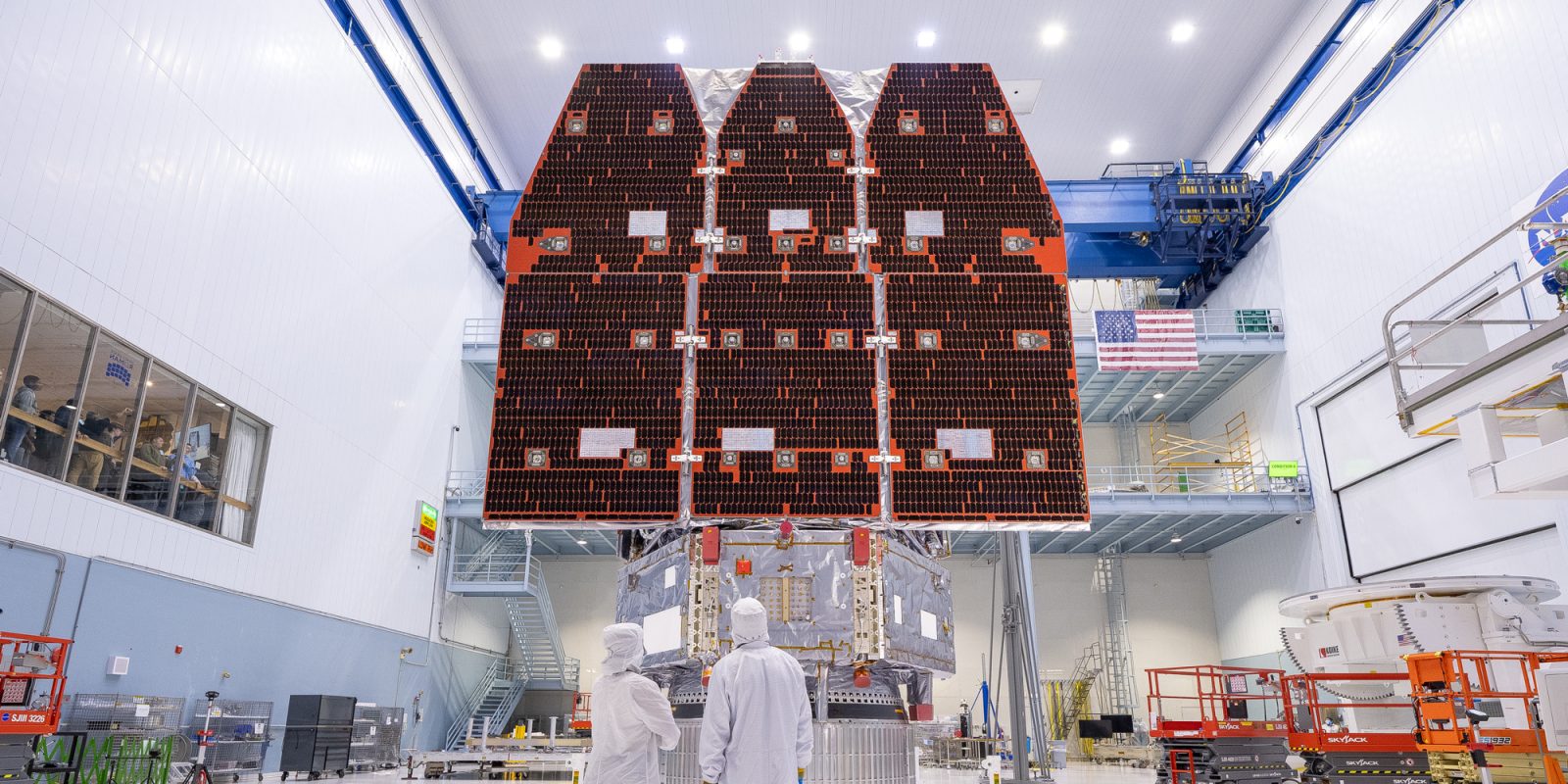
As NASA moves deeper into a new era of space-based astronomy, another flagship observatory is quietly approaching the launch pad. The Nancy Grace Roman Space Telescope, designed to survey the universe at a scale no previous space telescope has achieved, has completed assembly and is undergoing final environmental testing ahead of being shipped to Kennedy Space Center in Florida for a planned liftoff as soon as late 2026.
The Roman Space Telescope is positioned as NASA’s next major astrophysics observatory after the Hubble Space Telescope and James Webb Space Telescope. It began as the Wide-Field Infrared Survey Telescope, a mission prioritized in the 2010 Decadal Survey as a top recommendation for advancing cosmology and exoplanet science. Ten years later, the mission was renamed in honor of Nancy Grace Roman, NASA’s first chief of astronomy, who played a foundational role in establishing the agency’s space-based observatory program, which ultimately led to Hubble’s launch in 1990.
Unlike Webb, which specializes in ultra-deep infrared observations of targeted regions, Roman is designed for wide-field survey science. Its 2.4-meter primary mirror – comparable in size to Hubble’s – feeds the Wide Field Instrument, which is capable of capturing images with an angular resolution comparable to Hubble’s across a field of view roughly 100 times larger. That scale would allow Roman to observe vast portions of the sky with statistical power that previous space telescopes simply could not achieve.
One of Roman’s primary science goals is to investigate the nature of dark energy, the poorly understood phenomenon driving the accelerated expansion of the universe. The telescope is expected to conduct high-precision measurements of weak gravitational lensing – tiny distortions in the apparent shapes of distant galaxies caused by intervening dark matter – as well as map large-scale galaxy clustering across cosmic time. Together, those datasets are expected to provide new constraints on cosmological models and the growth of structure in the universe.
Roman will also conduct an extensive exoplanet microlensing survey toward the galactic bulge. Gravitational microlensing occurs when a foreground star briefly magnifies the light of a background star, revealing the presence of orbiting planets. This method is particularly sensitive to planets in wider orbits, including cold, Earth-mass planets, and even free-floating planets not bound to any star. NASA projects that the telescope could detect thousands of new exoplanets using this technique, filling in population gaps not accessible to transit surveys like Kepler or TESS.
In addition, Roman carries a technology-demonstration coronagraph instrument designed to suppress starlight and directly image faint circumstellar environments. While not a primary science driver, the coronagraph is widely viewed as an important step toward future missions aimed at directly imaging Earth-like planets in habitable zones.
NASA has contracted SpaceX to launch Roman aboard a Falcon Heavy rocket. Liftoff is currently targeted for late 2026, with a window extending into early 2027. Once in space, Roman will travel to the Sun-Earth L2 Lagrange point, approximately 1.5 million kilometers from Earth. This is the same semi-stable gravitational region where the James Webb Space Telescope operates.
If schedules hold, Roman could soon begin delivering large-scale survey data that complements Webb’s deep, targeted observations. Rather than replacing existing observatories, Roman is structured to expand the field, generating wide statistical datasets that could reshape cosmology and exoplanet demographics over the coming decades.


FTC: We use income earning auto affiliate links. More.


Comments