
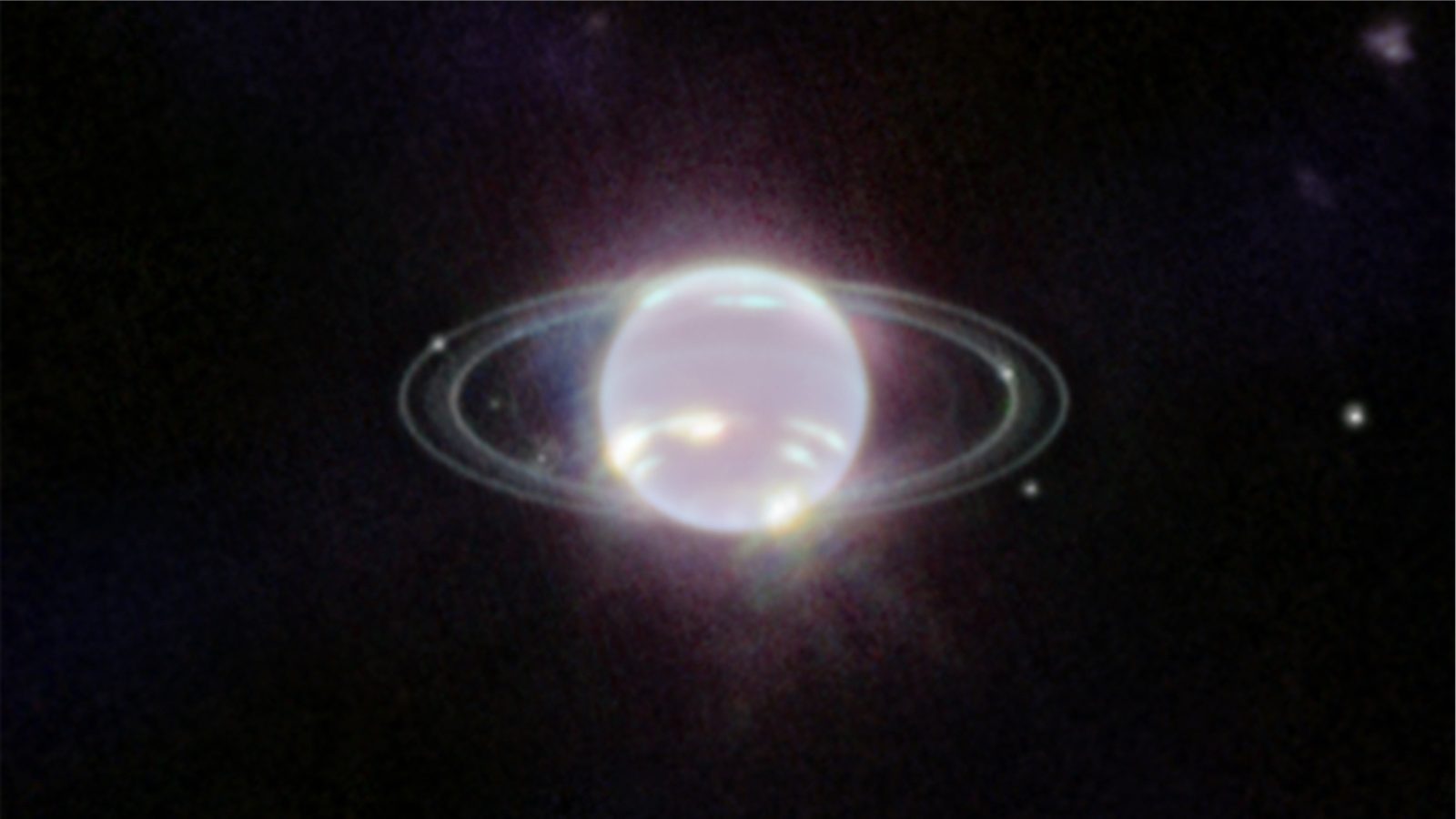
More than three decades after Voyager 2 became the only spacecraft to fly past Neptune, NASA’s James Webb Space Telescope is revealing that the distant ice giant may have experienced one of the most dramatic events in the solar system’s history.
A new study published in Science Advances suggests Neptune’s original family of moons was largely destroyed billions of years ago before the planet’s present-day inner moons and rings formed from the aftermath. The findings offer some of the strongest chemical evidence yet, supporting a hypothesis planetary scientists have debated for decades.
Using Webb’s Near-Infrared Spectrograph, researchers observed Neptune’s rings and three of its innermost moons – Larissa, Galatea and Proteus. Except on Proteus, the telescope detected magnesium-rich phyllosilicates, a type of hydrated clay mineral that forms when liquid water interacts with rock over extended periods of time.
However, none of the observed moons or rings were shown to be dominated by water ice. The three moons are simply too small to have generated the internal heat needed to sustain liquid water long enough for those minerals to form. Instead, the researchers conclude the material most likely originated deep inside a much larger icy body that existed much earlier in Neptune’s history.
That conclusion fits a long-standing hypothesis involving Triton, Neptune’s largest moon.
Unlike the major moons orbiting Jupiter, Saturn and Uranus, Triton travels around Neptune in a retrograde orbit, moving in the opposite direction of the planet’s rotation. This has long led scientists to conclude Triton was not formed around Neptune but was instead captured after forming in the Kuiper Belt beyond the planet.
Researchers believe Triton’s capture dramatically altered Neptune’s original satellite system.
As Triton’s orbit evolved, its gravity likely destabilized many of Neptune’s first-generation moons, triggering collisions that broke apart much of the original system, forming a debris disk. Over time, that debris is thought to have reassembled into the smaller inner moons and faint rings that surround Neptune today.
The minerals detected by Webb provide new evidence supporting that scenario. Because hydrated clay minerals form under conditions expected deep inside larger planetary bodies, researchers believe fragments from those ancient interiors may have survived the collisions before becoming incorporated into the moons and rings observed today.
Because Proteus was observed to contain hydrated material similar to Larissa and Galatea, but lacks phyllosilicates, the researchers suggest that it may have formed from a different area of the debris disk, or was dehydrated by intense heat during formation.
If these interpretations are correct, Webb has effectively provided scientists with a rare opportunity to study material from the interior of planetary bodies that no longer exist. It also suggests that Neptune’s inner system has a far more complex geological history than previously understood.
The discovery also demonstrates the expanding scientific reach of the James Webb Space Telescope. While the observatory is widely known for studying the earliest galaxies and probing the atmospheres of distant exoplanets, its infrared instruments are also providing an unprecedented view of our own solar system. By identifying the chemical fingerprints preserved on distant moons and planetary rings, the telescope is helping scientists reconstruct events that occurred billions of years ago.
Although the capture of Triton remains the leading explanation for Neptune’s unusual satellite system, the researchers also considered another possibility – that a Pluto-sized object passing close to Neptune could have been torn apart by the planet’s gravity, producing similar debris. Based on the available evidence, however, Triton’s capture continues to provide the best explanation for the observations.
Neptune remains one of the least explored planets in the solar system. Since Voyager 2’s historic flyby in 1989, astronomers have relied almost entirely on increasingly powerful telescopes to study the distant world. With Webb now revealing details that were previously beyond reach, researchers are continuing to uncover evidence that Neptune’s seemingly quiet appearance conceals a remarkably dynamic past.
The latest observations suggest that the planet’s present-day moons and rings are not simply leftovers from its formation, but the products of an ancient event that fundamentally reshaped the entire system. By tracing the chemistry preserved within a handful of small moons, scientists are piecing together a chapter of solar system history that has remained hidden for billions of years.


FTC: We use income earning auto affiliate links. More.



Comments