
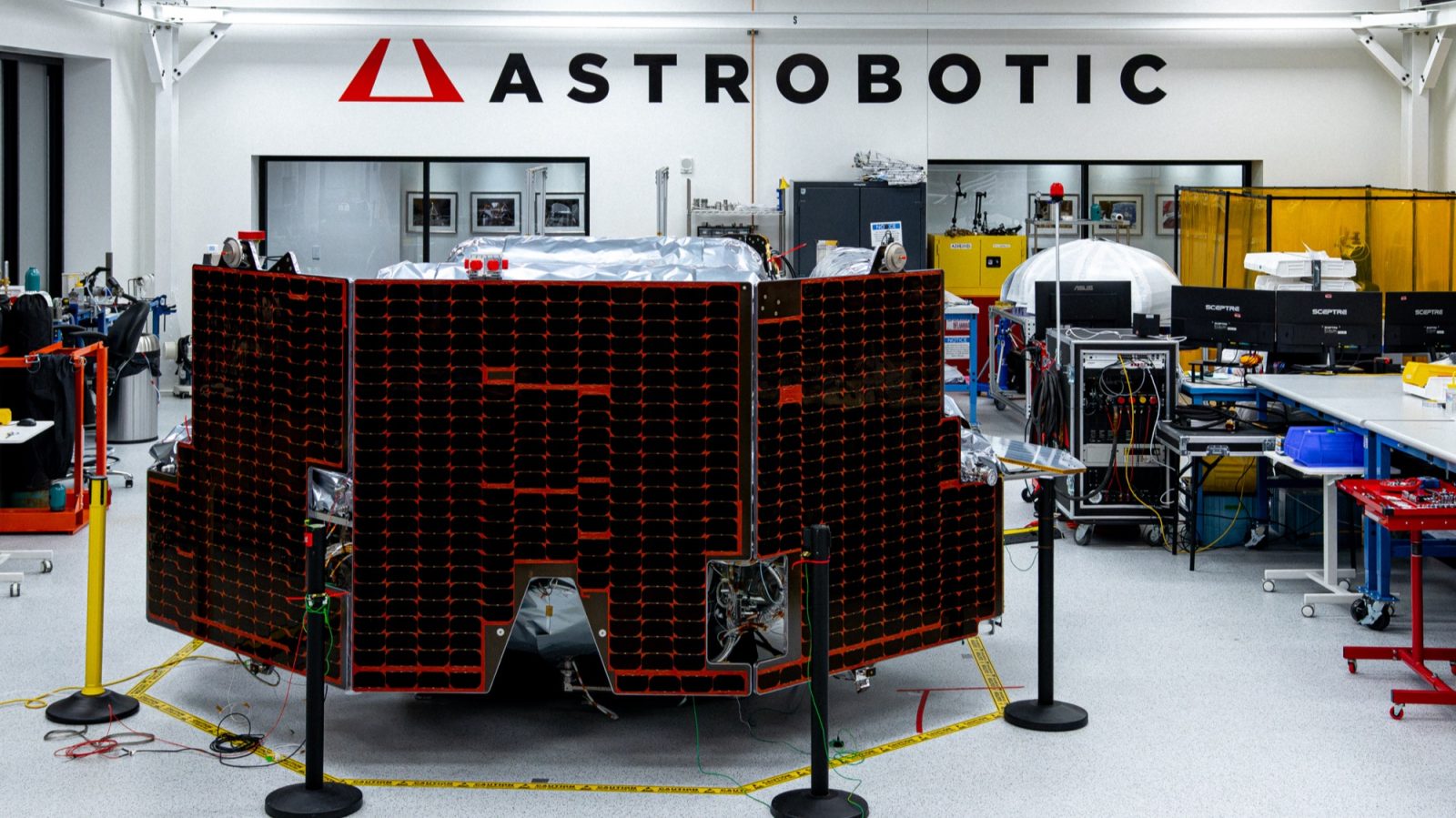
When people think about NASA’s Artemis program, they usually picture astronauts exploring the lunar surface. But before astronauts can live and work on the Moon for weeks at a time, someone has to deliver the equipment they’ll need. Astrobotic’s Griffin lunar lander is designed to do exactly that.
The Griffin-1 lander, designated as “Moon Base II” earlier this year by NASA, is now undergoing environmental testing at NASA’s Jet Propulsion Laboratory. The lander is one of several commercial spacecraft supporting Artemis. It’s designed to carry cargo, technology demonstrations, and robotic vehicles to the Moon’s south pole, helping NASA prepare for a sustained human presence on and around the Moon.
Unlike the Apollo program in the 1960s and 1970s, which was managed through traditional government contracting, Artemis relies more heavily on commercial partnerships. Through NASA’s Commercial Lunar Payload Services program, CLPS, companies such as Astrobotic, Intuitive Machines, Firefly Aerospace, and Blue Origin develop delivery services while NASA purchases transportation to the Moon as a customer. The goal is to create a reliable commercial transportation network capable of repeatedly carrying scientific instruments, cargo, and infrastructure to the Moon.
Griffin is among the largest lunar landers developed under CLPS. When it launches, it will ride aboard a SpaceX Falcon Heavy from Launch Complex 39A at NASA’s Kennedy Space Center in Florida. The mission is currently targeted for launch in late 2026, pending completion of spacecraft testing and integration.
Griffin takes its name from the legendary creature of mythology with the body of a lion and the head and wings of an eagle. For centuries, griffins have symbolized strength, courage, and the protection of great treasures. Astrobotic says the name reflects the spacecraft’s role as a cargo carrier and protector of valuable payloads.
The spacecraft has been through several major changes since it was first announced. Originally, Griffin was selected to carry NASA’s VIPER (Volatiles Investigating Polar Exploration Rover), a rover designed to search for water ice near the Moon’s south pole. Scientists have found strong evidence that water ice exists within permanently shadowed craters near the lunar poles, and those deposits could eventually provide drinking water and oxygen, while also producing propellants for future spacecraft.
However, VIPER experienced years of schedule delays while development costs continued to climb. NASA ultimately canceled the original mission plan in 2024, citing concerns that additional funding and schedule growth could affect other lunar exploration priorities. Rather than ending Griffin’s mission, NASA chose to move forward with the lander while exploring other ways to fly VIPER.
But VIPER’s mission was not over. NASA later awarded Blue Origin a CLPS task order to deliver VIPER aboard a Blue Moon Mark 1 lander, preserving a major lunar science mission. In other words, NASA canceled the original flight plan, not the science itself. VIPER will still search for water ice, just delivered by a different surface lander.
Meanwhile, Griffin evolved into a broader technology demonstration mission.
Instead of carrying NASA’s VIPER science rover, the lander is now focused on demonstrating technologies that support sustained lunar exploration. One of its primary payloads is now Astrolab’s FLIP (FLEX Lunar Innovation Platform) rover, designed to test cargo handling, surface mobility, and logistics concepts that could support future Artemis missions. Griffin-1 will deliver more than 500 kilograms of cargo to the Moon’s south pole, making it one of the largest commercial lunar cargo deliveries planned so far.
Landing near the Moon’s south pole is far more challenging than many people realize. The region contains steep slopes, deep craters, large boulders, and permanently shadowed areas where sunlight never reaches the surface. Griffin is equipped with autonomous landing technologies that allow it to detect hazards during descent and select a safer landing location. These precision landing capabilities will be important for future cargo missions and could eventually support missions carrying astronauts.
For Astrobotic, Griffin is more than a delivery mission. It is a chance to demonstrate the company’s ability to land and operate on the Moon.
Griffin-1 follows the company’s Peregrine Mission One, which successfully launched in January 2024 but suffered a propulsion-system anomaly shortly after reaching space, preventing its planned lunar landing. Griffin incorporates lessons learned during Peregrine’s development and mission review, and benefits from additional testing and engineering improvements. A successful mission would provide another step toward establishing a reliable commercial lunar transportation network.
Astrobotic’s Griffin is not simply another spacecraft headed to the Moon. It represents a shift in how space exploration is conducted. Rather than designing and operating every spacecraft itself, NASA is creating an ecosystem where commercial companies can eventually provide routine delivery of cargo, robotic vehicles, scientific instruments, and infrastructure to the lunar surface.
The technologies Griffin is helping demonstrate will eventually be needed far beyond the Moon.
Every robotic landing provides engineers with experience in transporting equipment, landing on another world, operating remotely, and supporting future human exploration. Those lessons could eventually help enable future missions to Mars, where astronauts will depend on robotic cargo deliveries before they set foot on the Red Planet.
In many ways, Griffin is helping demonstrate the technologies that could make humanity’s next giant leap possible – not just back to the Moon, but eventually onward to Mars.


FTC: We use income earning auto affiliate links. More.


Comments