
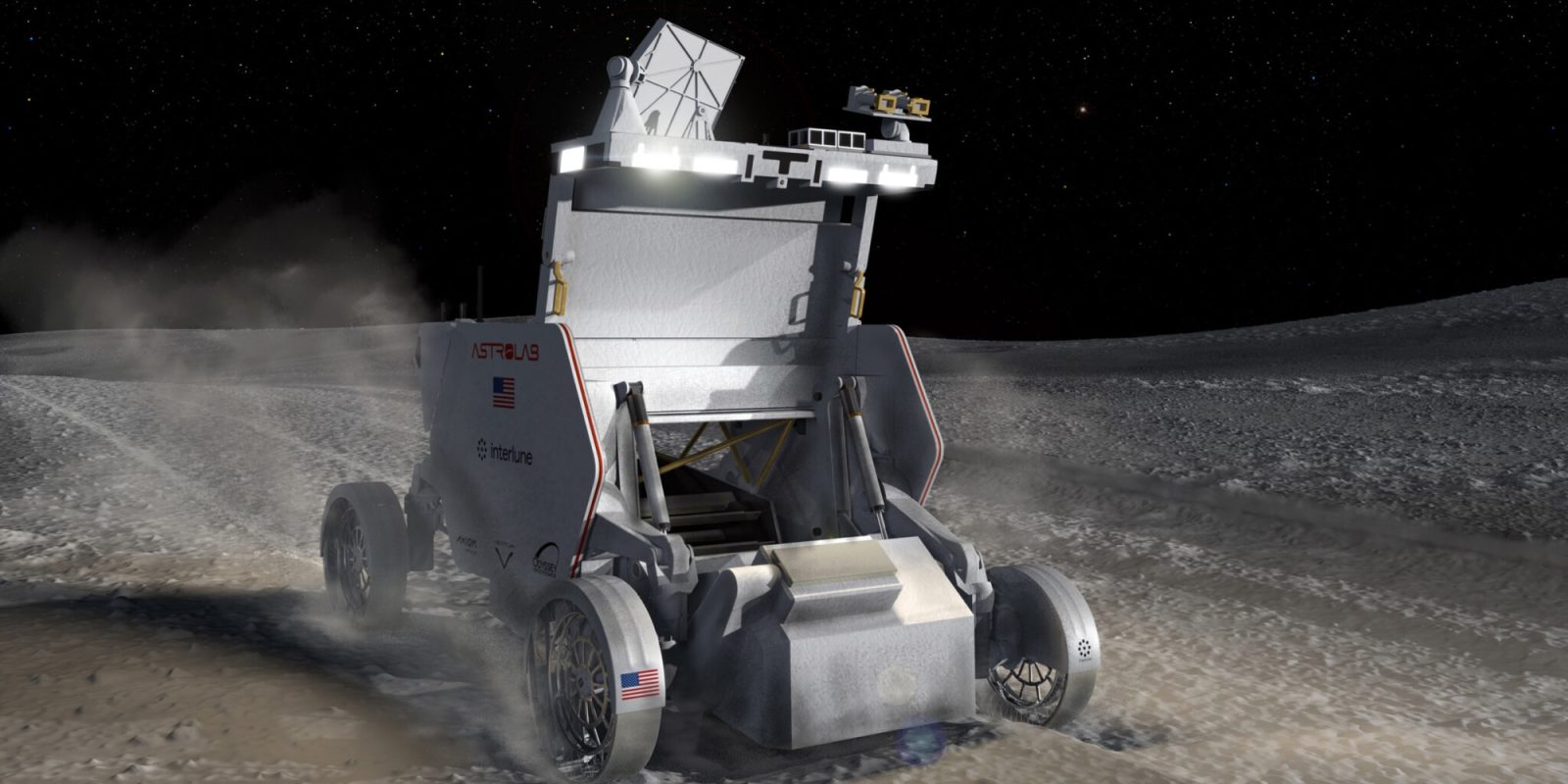
Astrolab and Interlune announced plans to collaborate on integrating excavation technology with Astrolab’s FLEX rover platform. Prototype testing is expected to take place at the Texas A&M University Space Institute, currently under construction near NASA’s Johnson Space Center in Houston.
Astrolab says it was the first company to lease space at the Texas A&M University Space Institute facility. The institute is being developed at Exploration Park, adjacent to Johnson Space Center, as a university-led research and collaboration hub focused on space engineering and technology development.
The Space Institute is designed to support research in robotics, autonomous systems, mobility platforms, and advanced space technologies. According to NASA, Exploration Park’s proximity to the agency’s human spaceflight operations is intended to foster collaboration between academia, commercial partners, and the broader spaceflight community.
The Astrolab and Interlune collaboration centers on integrating excavation and resource-related technologies onto the FLEX rover, a modular lunar mobility platform designed for commercial and governmental missions. While Interlune has previously announced plans to fly a multispectral camera on Astrolab’s planned FLIP mission to assess helium-3 concentrations in lunar regolith, the newly announced work expands that relationship to include surface excavation development.
Excavation and regolith handling are widely recognized as foundational capabilities for sustained lunar surface operations. Applications may include site preparation, regolith movement, and infrastructure support. Developing those systems requires terrestrial testing environments that can accommodate robotics validation, materials interaction studies, and hardware iteration cycles.
The Texas A&M Space Institute’s emerging facilities are intended to provide laboratory and engineering space for precisely that type of systems development. By locating research and testing infrastructure near Johnson Space Center, the institute adds to Houston’s expanding role in commercial space engineering alongside NASA’s long-established human spaceflight operations.
While lunar resource utilization remains an emerging area of development, the collaboration between Astrolab and Interlune comes as companies and space agencies are working to develop the infrastructure needed to support sustained lunar exploration as part of NASA’s Artemis program.


FTC: We use income earning auto affiliate links. More.


Comments