
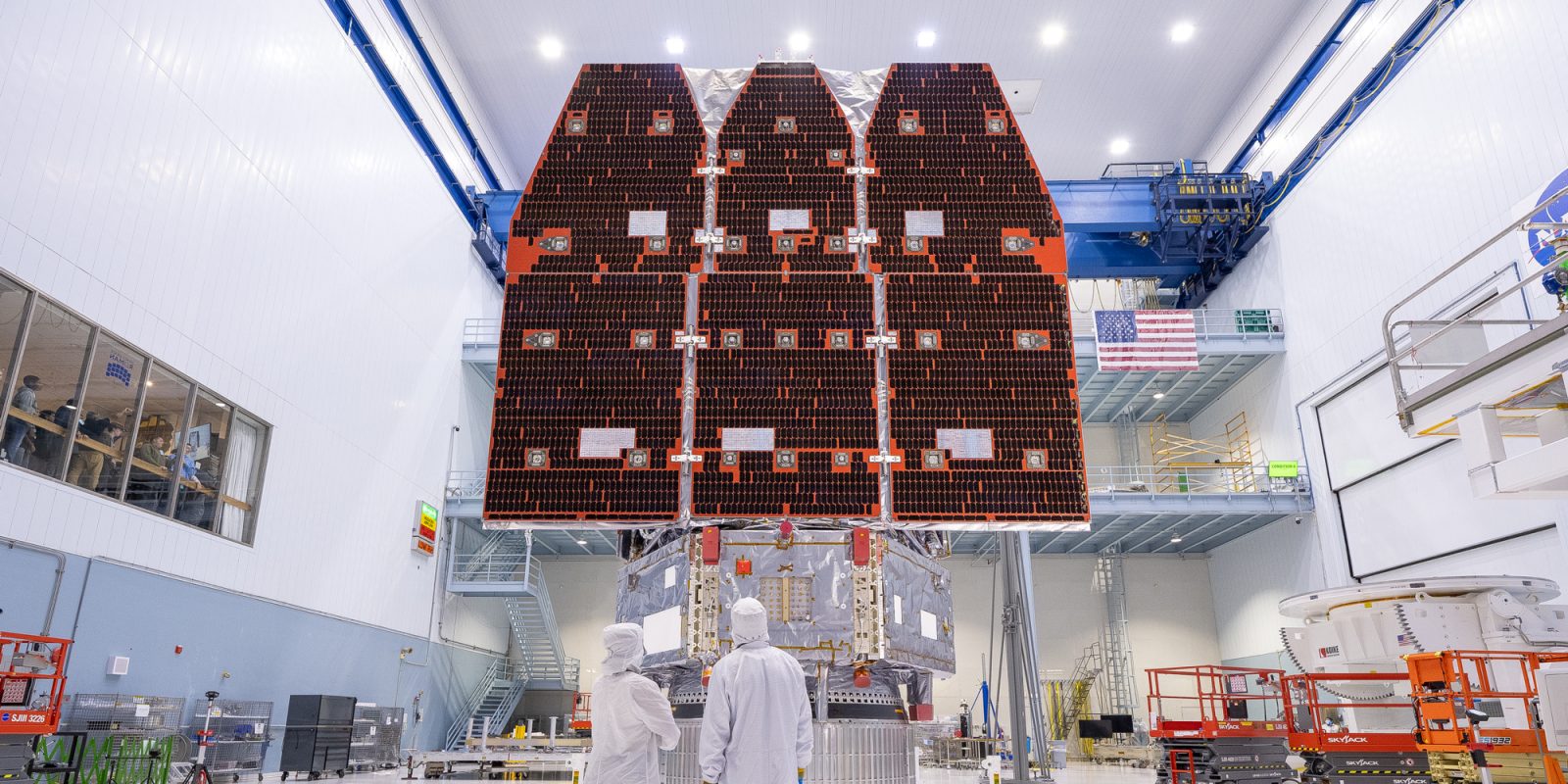
NASA’s next great observatory is no longer a distant concept sitting quietly in development labs. The Nancy Grace Roman Space Telescope is now entering its final stretch toward launch, and across the space community, anticipation around the mission has grown dramatically in recent months.
NASA is targeting an Aug. 30 launch for Roman aboard a SpaceX Falcon Heavy rocket from Launch Complex 39A at Kennedy Space Center in Florida, the same historic pad once used for Apollo missions.
The observatory itself is already complete. At NASA’s Goddard Space Flight Center in Maryland, Roman recently finished major assembly and environmental testing, which has moved the mission into final prelaunch preparation. Agency officials have emphasized that the telescope is progressing ahead of its previous schedule target and remains under its expected budget profile, something increasingly rare for flagship-class science missions.
NASA Administrator Jared Isaacman has publicly praised the pace and readiness of the program, highlighting Roman as an example of how NASA science missions can move efficiently while still pursuing ambitious goals.
Scientifically, Roman is designed to answer some of the biggest unanswered questions in astrophysics.
The telescope carries a 2.4-meter primary mirror, roughly the same size as Hubble’s, but Roman’s strength is not magnification alone. Its major advantage is field of view. NASA says Roman will be able to image sections of the sky about 100 times larger than Hubble can capture in a single observation while maintaining extremely high resolution.
That combination allows the telescope to perform massive sky surveys at a scale astronomers have never had before.
Researchers hope the mission will help map the distribution of dark matter across the universe and study how dark energy may be influencing the accelerating expansion of space itself. Roman will also examine how galaxies formed and evolved over billions of years through observations of enormous galaxy populations across cosmic time.
Another major objective involves exoplanet science. Using gravitational microlensing, Roman is expected to detect thousands of planets beyond our solar system, including free-floating planets and worlds that orbit far from their stars and are difficult for other telescopes to identify.
Scientists believe the mission could dramatically expand understanding of how planetary systems form and how common different types of planets may be throughout the Milky Way.
One of the telescope’s most closely watched technologies is its Coronagraph Instrument, designed to block starlight in order to directly image faint nearby planets. While considered a technology demonstration, researchers see it as an important step toward future observatories that could eventually study Earth-like planets in detail.
Roman also arrives during a broader transition period for NASA. Alongside Artemis lunar missions, commercial launch partnerships, and next-generation deep-space systems, the telescope represents a major investment in fundamental science and long-duration observation programs.
Rather than focusing on a narrow region of space, Roman is designed to survey vast portions of the universe with unprecedented efficiency, creating vast datasets that astronomers are expected to study for decades after launch.


FTC: We use income earning auto affiliate links. More.


Comments