
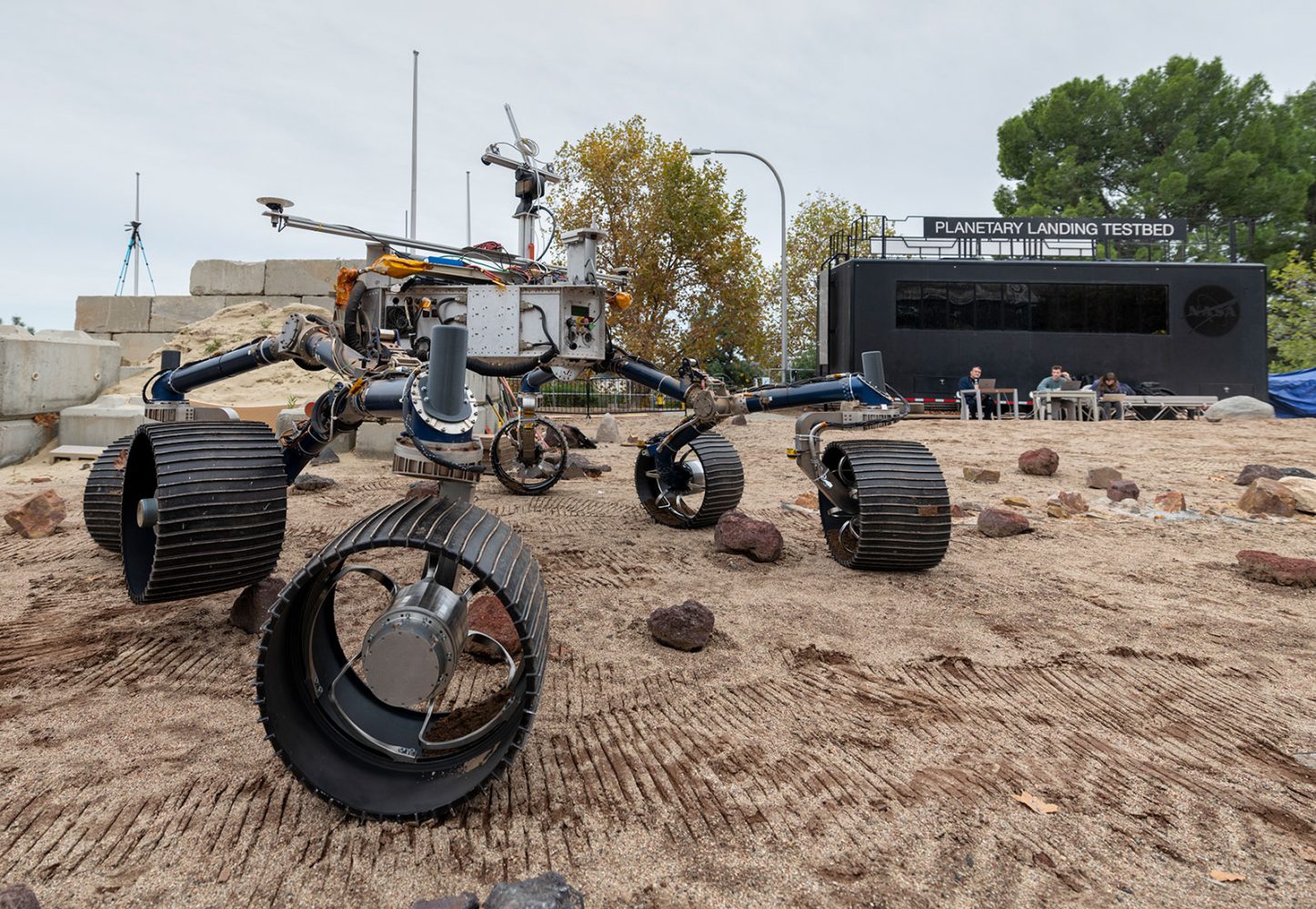
NASA has a new idea for a lunar rover, but the vehicle itself is already familiar. During a June 30 Moon Base update, the agency unveiled PROMISE – the Polar Rover for Observation, Mapping, and In-Situ Exploration. The proposed rover mission began life as an Earth-based engineering testbed at NASA’s Jet Propulsion Laboratory in Southern California, and is being studied to see if it can be modified to survive on the Moon.
Originally called OPTIMISM – Operational Perseverance Twin for Integration of Mechanisms and Instruments Sent to Mars – this rover was built as a ground-based twin to the Mars Perseverance rover. It has spent years helping engineers test software, driving sequences, robotic arm movements, and other commands before they were sent to the Red Planet.
Now, NASA is evaluating whether that same rover can be repurposed for a mission to the Moon. Like Perseverance, it would be powered by a radioisotope thermoelectric generator, rather than solar panels, which would allow it to more easily venture into craters where the sun rarely shines, if at all. The power source would also act as a way to keep the vehicle warm during the cold, long lunar nights.
The announcement came as part of a broader package of Moon Base technologies and commercial lunar initiatives aimed at supporting long-term exploration near the Moon’s south pole. Rather than beginning with an entirely new rover design, NASA is studying whether an existing engineering platform can be adapted into a flight-ready science mission.
If selected, PROMISE would take on a very different role than the one it has served at JPL.
Instead of operating as a test platform on Earth, the rover would explore the lunar south polar region, where NASA plans to establish a sustained human presence through Artemis. According to NASA, PROMISE would characterize the lunar surface and subsurface while prospecting for resources that could support future human exploration.
Its work would focus on gathering information that would be valuable long before astronauts arrive. NASA says the rover would study the properties of the lunar soil, map terrain, investigate subsurface features, and search for resources, including areas that may contain water ice and other materials that could support future missions. The data would expand our understanding of one of the most scientifically interesting and operationally important regions on the Moon.
Those measurements have practical value as well. Better knowledge of the terrain, soil conditions, and available resources could help mission planners determine where future infrastructure may be placed, identify potential hazards, and better prepare for long-duration crewed Artemis operations near the lunar south pole.
The proposal also reflects a broader approach NASA has increasingly adopted – finding new uses for proven hardware whenever practical. Developing a new planetary rover requires years of engineering, testing, and qualification. Using an existing engineering platform could reduce development effort compared with starting from scratch, while building on years of operational experience gained at JPL.
NASA has not detailed what modifications would be required to prepare PROMISE for flight, but transforming a ground-based engineering vehicle into a lunar mission would likely require extensive work before launch.
PROMISE also highlights the complementary roles of robotic and human exploration. Robotic missions can collect scientific data, evaluate terrain, and identify potential hazards before astronauts arrive. By the time Artemis crews begin working in the same region, mission planners could use that information to better understand the environment and refine future exploration plans.
The rover remains a proposed mission, and NASA has not announced a launch date or finalized mission architecture. Even so, the concept marks a potential new chapter for a vehicle that was originally built to support exploration from the ground. After years of helping Perseverance operate on Mars, PROMISE could eventually begin an exploration mission of its own on the lunar surface.


FTC: We use income earning auto affiliate links. More.


Comments