
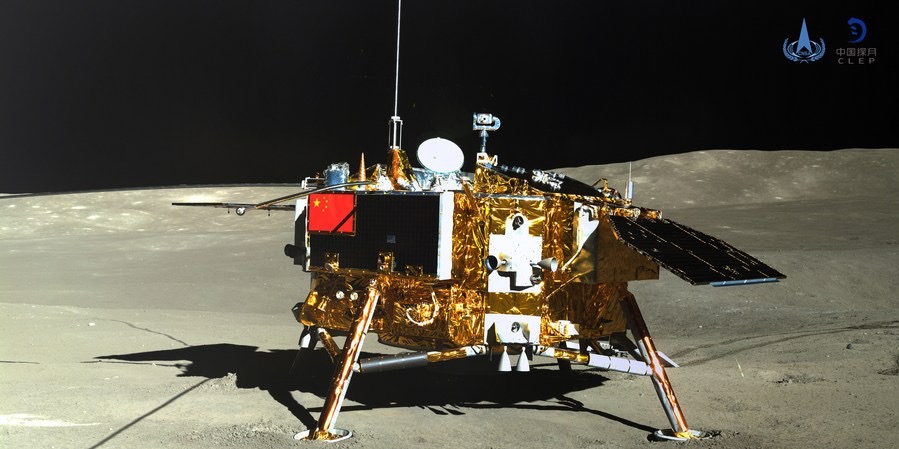
China’s upcoming Chang’e-7 mission, targeted for launch later this year, is officially framed as a scientific investigation of the Moon’s south pole. But viewed in context, it also represents a calculated step in a rapidly intensifying global race to establish long-term presence at the lunar poles, where science, technology development, and geopolitical competition increasingly intersect.
Chang’e-7 is part of “phase four” of China’s lunar exploration program, following a methodical progression over nearly two decades from orbital reconnaissance (Chang’e-1 and 2), to surface landings and rovers (Chang’e-3 and 4), and sample return missions (Chang’e-5 and 6). This step-by-step architecture mirrors how spacefaring nations historically reduce risk while steadily expanding operational capability.
Technically, Chang’e-7 is among the most complex robotic lunar missions attempted to date. Rather than a single spacecraft, it consists of an orbiter, lander, rover, and a small hopping probe designed to make short ballistic or assisted hops, supported by a relay satellite to maintain communications from the lunar south pole and far-side regions. The mission’s stated objective is to search for and characterize water ice and other volatiles near the lunar south pole, particularly within permanently shadowed regions – areas that never receive sunlight and may preserve ice over geologic timescales.

The science case is compelling. Water ice offers clues to the Moon’s formation and the delivery of volatiles across the inner solar system. More practically, water can be split into oxygen and hydrogen, making it a cornerstone resource for future human space exploration. Chang’e-7’s hopping probe is specifically designed to access terrain that wheeled rovers cannot, potentially providing the first in-situ measurements from deep inside a permanently shadowed crater.
However, Chang’e-7 also fits squarely within a broader strategic competition unfolding around the Moon’s poles. NASA’s Artemis program is targeting the same region, with plans to land astronauts near the south pole later this decade. Meanwhile, other nations, including India, Russia, Japan, and European partners, are advancing their own lunar initiatives.
The south pole region’s combination of resource potential and near-continuous sunlight at certain ridges makes it among the most valuable real estate on the Moon.
China officially describes Chang’e-7 as a scientific and exploratory mission, and it does include international instruments from partner countries. At the same time, the mission contributes to capabilities that extend beyond pure science: precision landing near hazardous terrain, long-duration surface operations, autonomous mobility, and resource prospecting. These are the same foundational technologies required for sustained human presence.
Chang’e-7 also serves as a precursor to Chang’e-8, which China has stated will test in-situ resource utilization and construction techniques, and to longer-term plans for an International Lunar Research Station in partnership with other nations. Together, these missions suggest a coherent roadmap toward permanent infrastructure rather than isolated exploration.
In the context of the modern space race, Chang’e-7 highlights a shift away from symbolic “firsts” toward operational permanence. The competition is no longer about reaching the Moon, it is about who can stay, operate, and extract value from it. Whether framed as science, exploration, or cooperation, Chang’e-7 positions China as a central actor in shaping the Moon’s next chapter.
As lunar exploration accelerates, Chang’e-7 stands as both a scientific mission and a strategic signal: the Moon is no longer a distant target, but an arena where technology, resources, and global influence increasingly converge.


FTC: We use income earning auto affiliate links. More.



Comments