
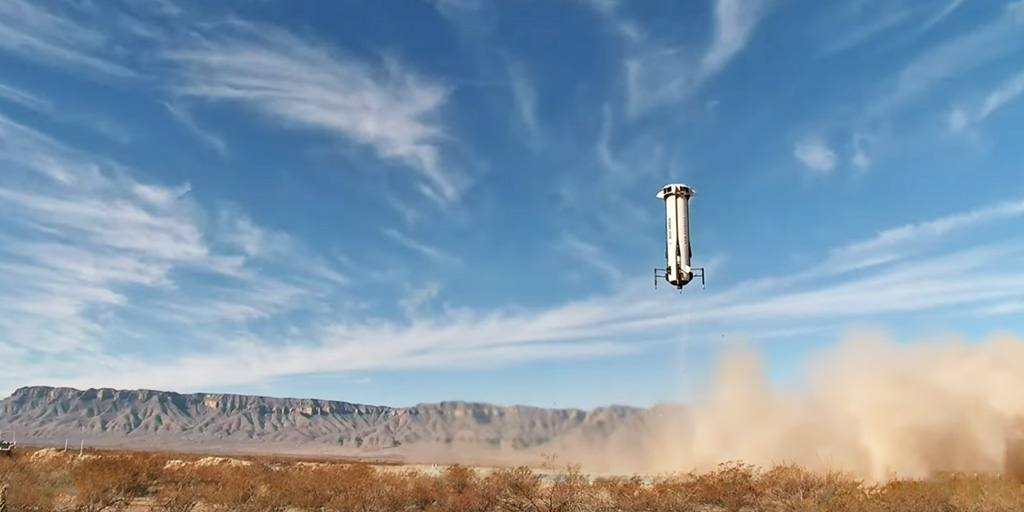
In a statement today, Blue Origin announced it was pausing all New Shepard launches for at least two years in order to shift its priorities to its lunar programs in support of national initiatives. This comes as the company has made multiple moves to bolster itself as a new player in national defense and civil space.
The news was straightforward and short: Blue Origin’s New Shepard rocket, a suborbital reusable rocket designed for high-altitude, zero-gravity flights for private customers and experiments, will be grounded for at least the next two years.
No executive statements or drawn out plans were made other than the company plans to focus on its lunar lander, Blue Moon, and likely its launcher, New Glenn.
While New Shepard has been a big success for Blue Origin, the nation’s priority is returning humans to the surface of the Moon by 2028, and so far, no audit of NASA’s Artemis program shows it can actually do that.
Blue Origin is working on a plan to potentially leapfrog SpaceX with its Starship rocket to be the crewed lander for Artemis 3. The accelerated timeline will require as many employees as the company can muster and that seems to mean launching customers for a short joy ride in micro-gravity can wait.
The last launch of the New Shepard rocket took place about a week ago. NS-38 flew six customers above the Kármán Line and returned them safely back to the ground. This has become a regular thing since the first crewed New Shepard launch in 2021 that flew Blue Origin founder Jeff Bezos, his brother, aviation icon Wally Funk, and Oliver Daemen to space.
While New Shepard won’t be flying again until at least 2028, Blue Origin still states it has a multi-year-long backlog of customers waiting to fly on it.
Space Explored’s Take
This is an exciting decision made by a company that feels to have grown up into early adulthood. New Shepard is a great program that lets its engineers cut their teeth on developing a spaceflight program from nothing. However, it’s now a product that has nearly reached its potential, and while still lucrative, no launch ticket can beat the potential funding from the US Government.
New Glenn, Blue Moon, and its recent Terrawave announcement are where Blue Origin will see its biggest revenue potential, but they all need more work.
New Glenn has the potential to take off (sorry for the pun) this year with regular commercial flights, if the company doesn’t run into any technical issues. Blue Moon could go into the history books with an Artemis 3 mission; it just needs to speed things up, and Terrawave could bring real competition to the satellite internet market.
All of this is far more important than likely having a few hundred talented engineers focused on sending a handful of billionaires and a very few lucky contest winners to space for a few minutes. Those engineers can now put their brainpower toward moving the needle on programs important to national interests.


FTC: We use income earning auto affiliate links. More.



Comments