
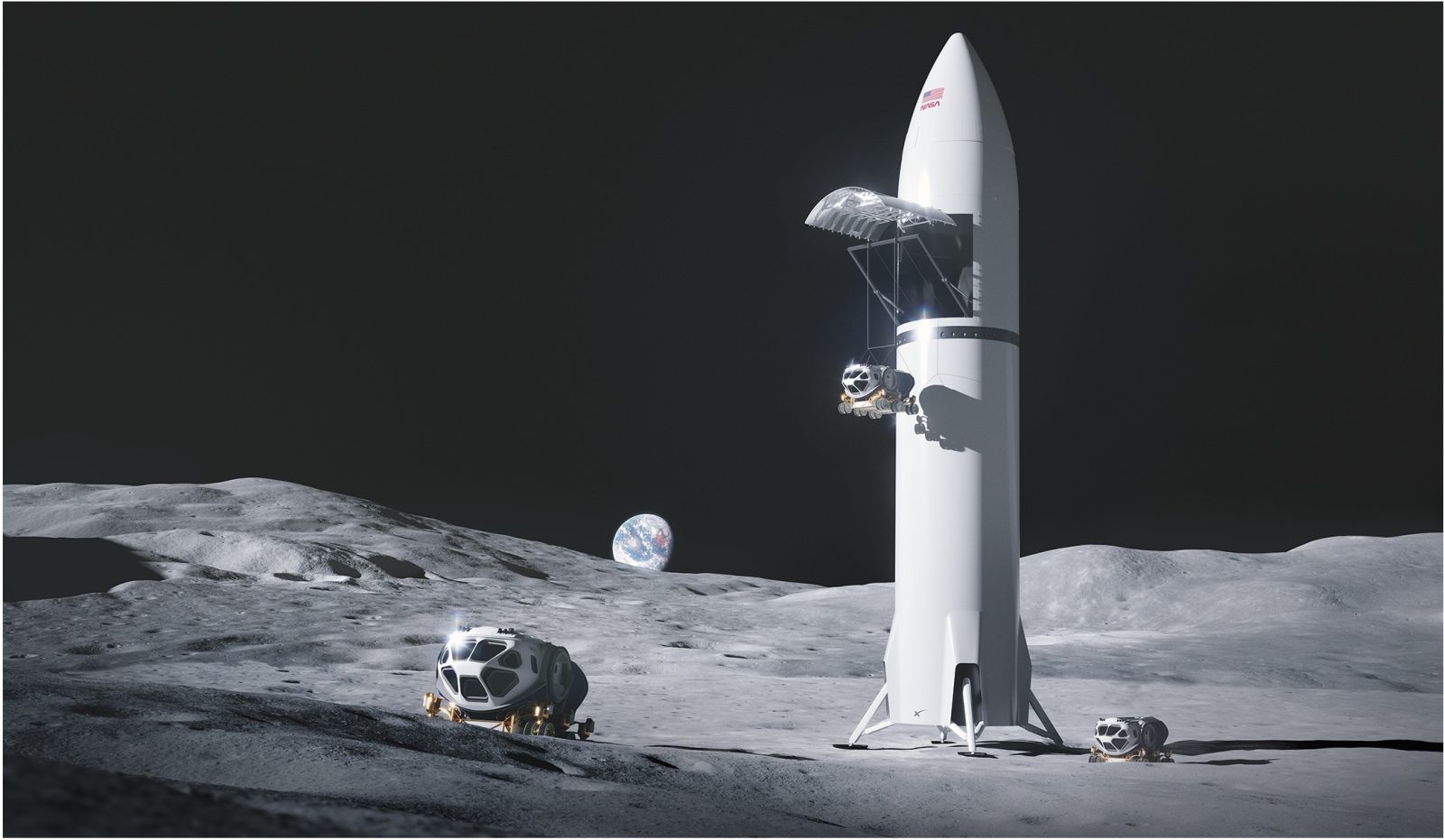
SpaceX is signaling a recalibration of its near-term priorities, placing renewed emphasis on the Moon as the fastest path toward a self-sustaining off-world settlement, while maintaining Mars as a longer-term objective. The shift is being framed not as a retreat from interplanetary ambition, but as a sequencing decision driven by logistics, cadence, and risk reduction.
The messaging comes directly from Elon Musk, whose recent statements have been widely reported and amplified across the space and business press. He said SpaceX believes a “self-growing city” on the Moon could potentially be achieved in under ten years, compared with timelines of twenty years or more for a comparable settlement on Mars.
The argument rests primarily on orbital mechanics and development speed. Mars missions are constrained by launch windows that open roughly every 26 months, with transit times of about six months each way. Musk said that cadence stretches learning cycles, increases mission risk, and slows the pace at which systems can be tested, refined, and scaled.
By contrast, the Moon sits just days away. Musk has argued lunar missions could, in theory, be launched as often as every ten days, with roughly two-day transit times, allowing rapid iteration across vehicles, life-support systems, surface operations, and logistics.
In this framing, the Moon becomes not merely a destination but a development platform. Faster turnarounds mean faster feedback, shorter recovery times after failures, and more frequent opportunities to validate hardware and procedures under real off-world conditions.
Musk has emphasized the Red Planet remains the ultimate goal, and early Mars settlement efforts could still begin within the next five to seven years. The distinction, he argues, is that the Moon offers a faster, more practical route to proving what a self-sustaining extraterrestrial city actually requires.
Independent reporting supports the idea that SpaceX is rebalancing its near-term focus. Coverage from Reuters, citing additional reporting from the Wall Street Journal, indicates the company has been delaying previously discussed Mars timelines and redirecting attention toward lunar objectives. One target referenced in reporting is an uncrewed lunar landing around 2027, though SpaceX has not formally committed to a public schedule. The reporting characterizes the move as a practical adjustment rather than a philosophical shift away from Mars.
The emphasis on the Moon also aligns with SpaceX’s existing role in NASA’s Artemis program, where the company is developing a Starship-based Human Landing System intended to ferry astronauts from lunar orbit to the surface. While Artemis schedules remain fluid and technically demanding, the Moon is where SpaceX’s current contractual and operational gravity is concentrated.
At the same time, Musk’s claims about launch cadence and timelines should be read as aspirational rather than confirmed capability. A lunar launch rate of every ten days would require sustained high-volume manufacturing, rapid vehicle turnaround, dependable in-space refueling, and consistent mission reliability – areas SpaceX continues to develop and refine. Reuters reports Musk’s cadence argument as part of his strategic rationale, not as a validated operational plan.
Still, the underlying logic resonates across the aerospace community. Proximity matters, and the Moon offers a nearby proving ground where failures are survivable, iteration is fast, and lessons learned can be applied without waiting years between missions. From that perspective, a Moon-first strategy functions as risk reduction rather than compromise.
The broader implication is that SpaceX is not lowering its ambitions, but reordering the path toward them. Verified reporting and Musk’s own statements point to the Moon as the fastest way to establish a durable human presence beyond Earth, while Mars remains the destination that follows once systems, logistics, and sustainability have been proven closer to home.


FTC: We use income earning auto affiliate links. More.


Comments