
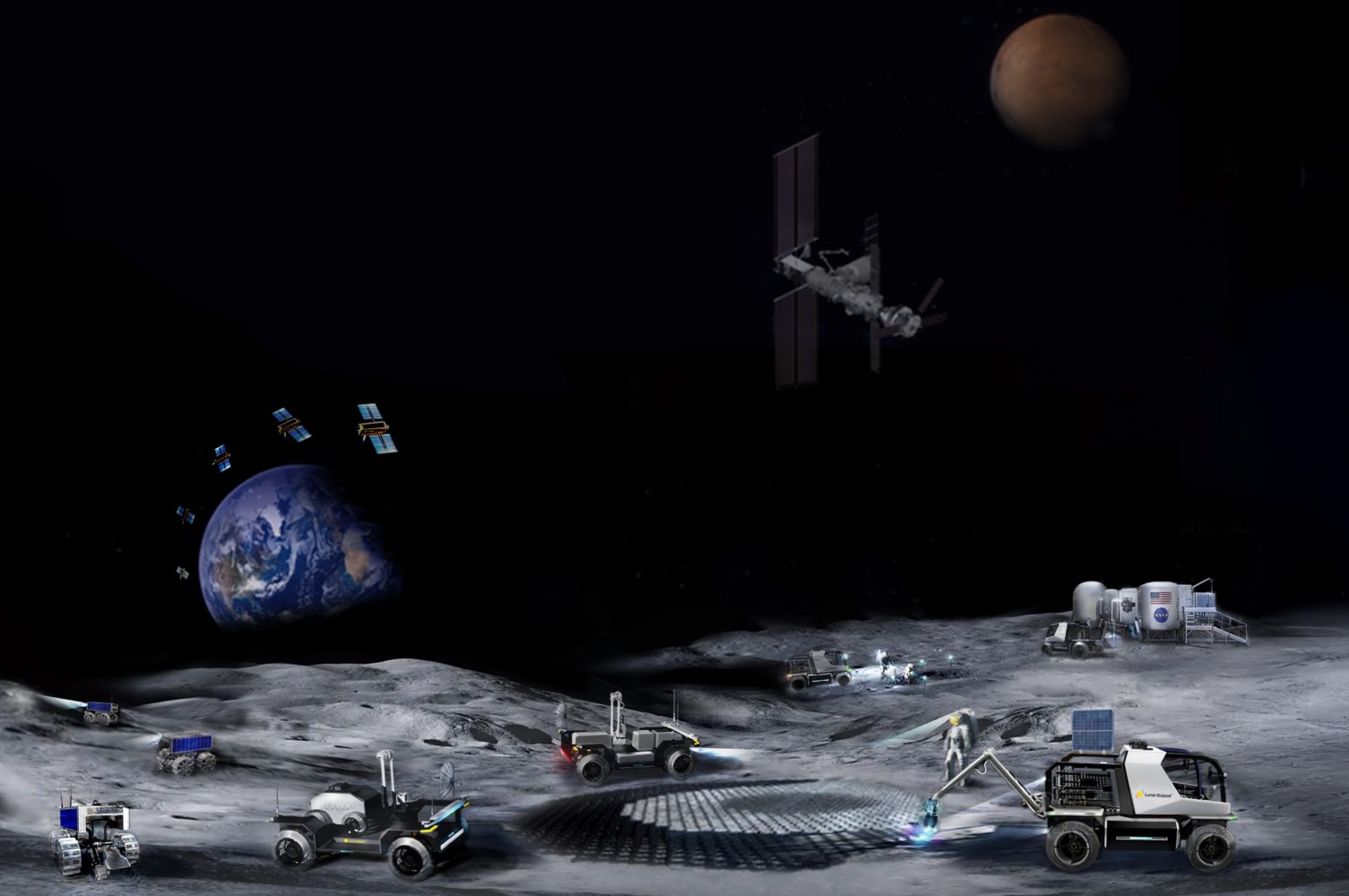
As NASA’s Artemis program moves from planning into early missions, public attention tends to focus on the spacecraft carrying astronauts back to the Moon. Heavy-lift rockets, crew capsules, and lunar landers dominate the conversation around humanity’s return to deep space. Yet beneath those visible systems, another layer of the space economy is beginning to take shape.
A new generation of venture capital firms is investing not in the spacecraft themselves, but in technologies that could support sustained operations in space. Among them is Balerion Space Ventures, a Dallas-based investment group focused on aerospace and space-infrastructure startups.
Founded in 2022, Balerion is part of a growing shift in how some investors are approaching the future of space exploration. Rather than concentrating primarily on satellite services or consumer applications, the firm targets foundational systems such as propulsion technologies, advanced energy systems, manufacturing capabilities, and communications infrastructure. These technologies may eventually play an important role in supporting long-duration missions beyond Earth orbit.
In some respects, the strategy echoes earlier industrial developments on Earth. Railroads, for example, depended not only on locomotives but also on steel production, telegraph networks, logistics systems, and energy infrastructure. Investors who supported those enabling technologies often helped shape the broader industrial ecosystem that followed.
A similar pattern may now be emerging in the space industry.
One of Balerion’s investments is Impulse Space, founded by former SpaceX propulsion chief Tom Mueller. The company is developing orbital transfer vehicles designed to move spacecraft and payloads between different orbits. Sometimes referred to as “space tugs,” these vehicles could support logistics across Earth orbit and potentially into the cislunar region by repositioning satellites and transporting cargo.
Energy systems are another area of focus. Companies such as Zeno Power are developing compact radioisotope power systems designed to provide long-duration energy for spacecraft and remote operations. Reliable power is expected to be an important requirement for future lunar missions, particularly during the roughly two-week lunar night when solar power is unavailable.
Other investments within Balerion’s portfolio focus on propulsion technologies, aerospace manufacturing, and rocket motor production, areas that could contribute to a broader industrial base supporting spaceflight.
For example, X-Bow Systems is working to modernize solid rocket motor production using advanced manufacturing techniques. Companies developing high-performance electric propulsion systems are also seeking to improve spacecraft maneuverability and mission endurance.
More recently, the firm participated in a funding round for Vast Space, which is developing a privately operated orbital station known as Haven-1. The station is planned to launch aboard a SpaceX Falcon 9 rocket and is intended as an early step toward commercial orbital stations as the International Space Station approaches retirement.
Communications infrastructure is another emerging part of the ecosystem. Companies such as Northwood Space are developing flexible ground-station networks designed to support a growing number of satellites and deep space missions.
What makes much of this investment activity notable is where it is occurring.
Texas has quietly become a growing hub for space infrastructure and aerospace investment. The state already hosts major launch and aerospace operations, including SpaceX’s Starbase facility in Boca Chica and the headquarters of Firefly Aerospace near Austin. The region also sits within the broader aerospace ecosystem surrounding NASA’s Johnson Space Center.
Lower operating costs, access to testing facilities, and proximity to aerospace engineering talent have made the region increasingly attractive to hardware-focused startups. For programs such as Artemis, this emerging industrial base could become an important supporting layer.
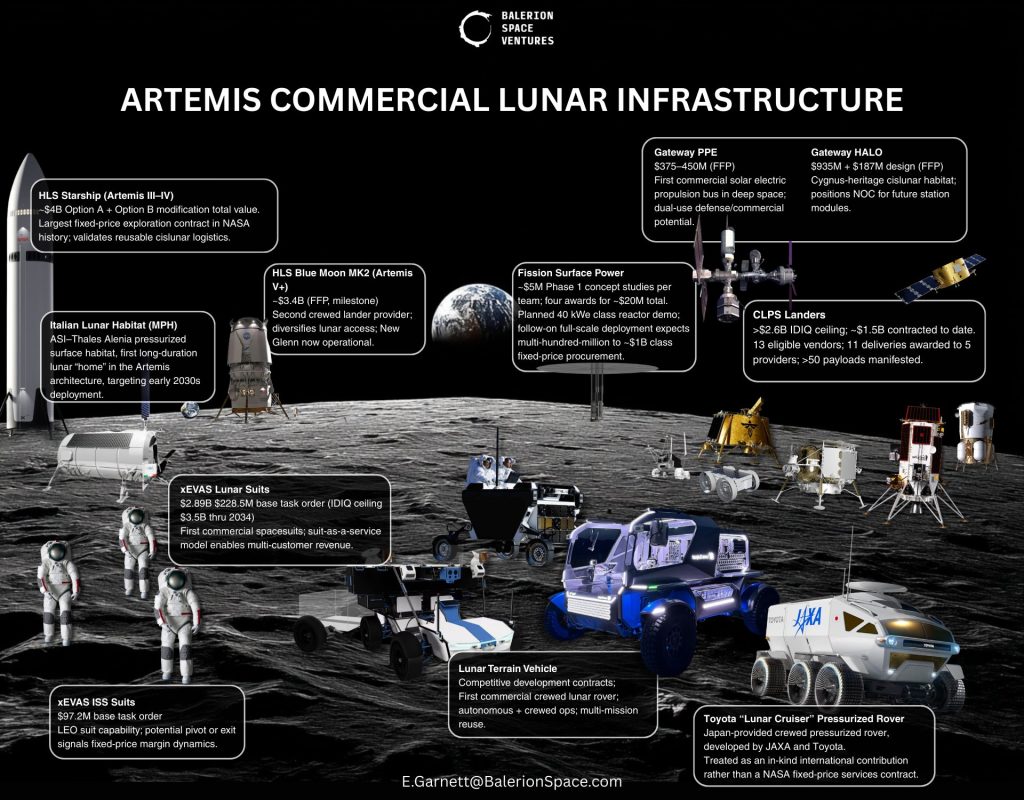
NASA’s current exploration strategy relies heavily on commercial partnerships. Lunar landers, cargo delivery systems, and many supporting technologies are now being developed by private companies through competitive contracts.
If sustained human activity on the Moon becomes possible, it will likely depend on a wide network of supporting systems, including propulsion, power generation, logistics vehicles, communications infrastructure, and manufacturing capabilities.
Many of those enabling technologies are now being developed by venture-funded startups. While the spacecraft flying to the Moon may capture the spotlight, the industrial systems developing quietly behind the scenes may ultimately determine how far – and how sustainably – humans operate beyond Earth.


FTC: We use income earning auto affiliate links. More.


Comments