
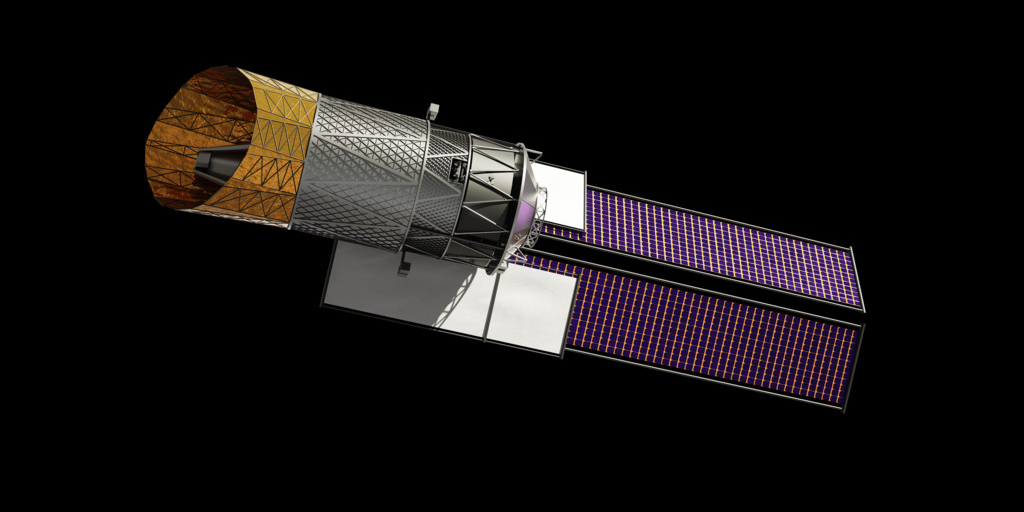
After three decades of discovering exoplanets, astronomers are turning to a harder question: which of those distant worlds might truly be capable of supporting life? NASA has taken an early step toward answering it by selecting industry partners to mature key technologies for the proposed Habitable Worlds Observatory, a next-generation space telescope designed to directly image Earth-like planets orbiting nearby stars.
Unlike most current space telescopes, which detect exoplanets indirectly through stellar motion or planetary transits, the Habitable Worlds Observatory is intended to observe planets directly. That capability would allow astronomers to analyze the faint reflected light from rocky worlds orbiting within the habitable zones of Sun-like stars, where liquid water could exist on planetary surfaces.
The technical challenge facing such an observatory is not size alone, but precision. Imaging a small, dim planet next to a bright star requires suppressing starlight by factors of one billion or more, while keeping the telescope’s mirrors aligned to distances smaller than the size of an atom, according to NASA. Even minor thermal or mechanical disturbances can overwhelm the faint planetary signal.
To address those challenges, NASA has awarded technology-development contracts to a group of aerospace and technology companies, including Lockheed Martin, Northrop Grumman, BAE Systems, L3Harris Technologies, Astroscale, Busek, and Zecoat. Their work focuses on advancing ultra-stable optical systems, vibration isolation, precision propulsion, and next-generation coronagraphs – specialized instruments designed to block a star’s glare so orbiting planets can be isolated.
Rather than rushing toward construction, NASA says it is maturing these technologies years in advance. This approach reflects lessons learned from previous flagship missions, where early design commitments increased cost and complexity. By reducing technical risk now, NASA aims to preserve flexibility as the mission architecture evolves.
If realized, the Habitable Worlds Observatory would move exoplanet science beyond discovery toward atmospheric characterization. By dispersing a planet’s light into a spectrum, the observatory could search for combinations of gases, such as oxygen, methane, and water vapor, that may indicate biological processes.
NASA scientists emphasize that no single chemical signature would be considered definitive evidence of life. Instead, the mission is designed to build a statistical understanding of how common Earth-like environments may be and how planetary atmospheres evolve under different stellar conditions.
NASA has not yet selected a prime contractor or construction site for the Habitable Worlds Observatory, underscoring that the mission remains in its technology-development phase. Based on precedent from previous flagship observatories, program management would likely be led by NASA Goddard Space Flight Center in Maryland, which manages the Hubble Space Telescope and is currently overseeing the Nancy Grace Roman Space Telescope.
Final assembly and integration would be expected to occur at the facility of a future industry prime contractor once NASA formally down-selects. Science operations would likely be handled by the Space Telescope Science Institute, which has operated space observatories like Hubble and the James Webb Space Telescope for decades. This phased approach would allow NASA to avoid committing to a single design before the most demanding technologies are proven.
The Habitable Worlds Observatory has been identified by the U.S. National Academies as the top priority for NASA’s next large astrophysics mission, following the James Webb Space Telescope and the Nancy Grace Roman Space Telescope. While the mission remains conceptual, current planning places a potential launch in the early to mid-2040s.


FTC: We use income earning auto affiliate links. More.


Comments