
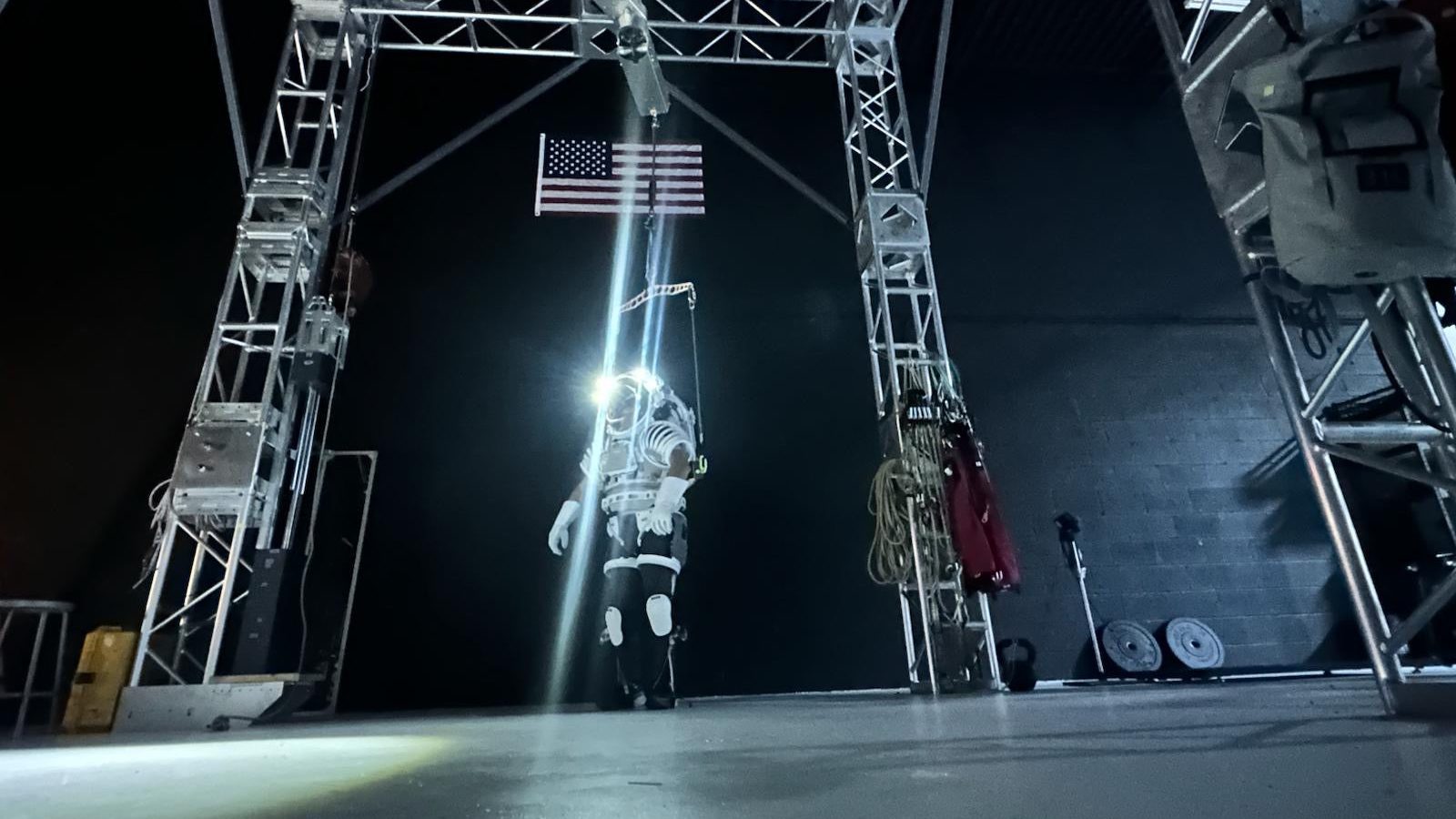
Before astronauts step onto the lunar surface, a Massachusetts engineering firm is using a gravity-defying simulator to ensure they can actually do their jobs once they arrive. By mimicking the Moon’s one-sixth gravity on Earth, Atlas Devices is helping engineers solve the ergonomic challenges that will ultimately dictate the success of crewed lunar exploration.
Returning humans to the Moon is only part of the challenge. Once they arrive, every task, from collecting rock samples to unloading cargo and deploying scientific instruments, must be performed while wearing a bulky spacesuit in one-sixth of Earth’s gravity. Before any of that can happen, however, engineers need to understand how astronauts, equipment and spacecraft will work together in an environment unlike anywhere on Earth.
Rather than building rockets or lunar landers, Atlas Devices is developing technologies that help engineers answer a different set of questions. Can an astronaut comfortably retrieve equipment from a storage compartment? Is a handrail positioned where it provides the greatest benefit? How much additional effort does a routine task require when performed inside a pressurized exploration suit? Those questions cannot be answered through computer models alone.
Atlas Devices specializes in human-in-the-loop testing, allowing engineers to evaluate how real people interact with hardware before it ever flies. By measuring movement, reach, mobility, and ergonomics, the company’s goal is to help identify operational challenges early, when design changes are still practical and far less costly than after launch.
At the center of that work is the Counterweight-Offload Astronaut Suited Test & Evaluation Rig, better known as COASTER. Instead of recreating the entire lunar environment, this platform simulates one of its most important characteristics: reduced gravity.
Using a dynamically controlled overhead offload system, COASTER reduces the effective weight carried by a test subject, allowing engineers to study natural walking, climbing, lifting, kneeling, and tool use under loading conditions that closely resemble those astronauts will experience on the Moon. Every movement has the potential to become engineering data.
Engineers can observe how astronauts perform specific tasks, then refine hardware layouts, vehicle interiors, workstations, or operational procedures based on measurable results. A storage compartment may need to be relocated. A tool interface may require a redesign. A ladder or handrail may prove more, or less, effective than expected. Small changes like these affect how efficiently a crew can work over days or weeks on the lunar surface.
To support those evaluations, Atlas Devices also developed EXploration CONop, or EXCON, a high-fidelity exploration suit simulator. While it is not a flight-qualified spacesuit, the device reproduces the suit’s overall geometry and many of the ergonomic constraints engineers must consider when planning lunar operations.
Used together, COASTER and EXCON allow engineers to evaluate procedures, hardware, and mission concepts with people performing realistic tasks instead of relying solely on computer simulations.
As NASA’s Artemis campaign shifts from demonstrating that astronauts can return to the Moon toward establishing a sustained human presence, this type of engineering is becoming increasingly important. Future crews are expected to conduct geological fieldwork, operate lunar vehicles, deploy scientific payloads, assemble surface infrastructure, and maintain equipment over missions lasting days or even weeks.
Success depends on far more than just powerful rockets and sophisticated spacecraft. It also depends on thousands of engineering decisions that determine how efficiently astronauts can work once they arrive.
Those decisions rarely make headlines, yet they often determine how much science can be conducted on the lunar surface. By enabling engineers to understand how astronauts will interact with their equipment long before a mission leaves Earth, Atlas Devices’ work factors into how those missions get designed.


FTC: We use income earning auto affiliate links. More.

Comments