
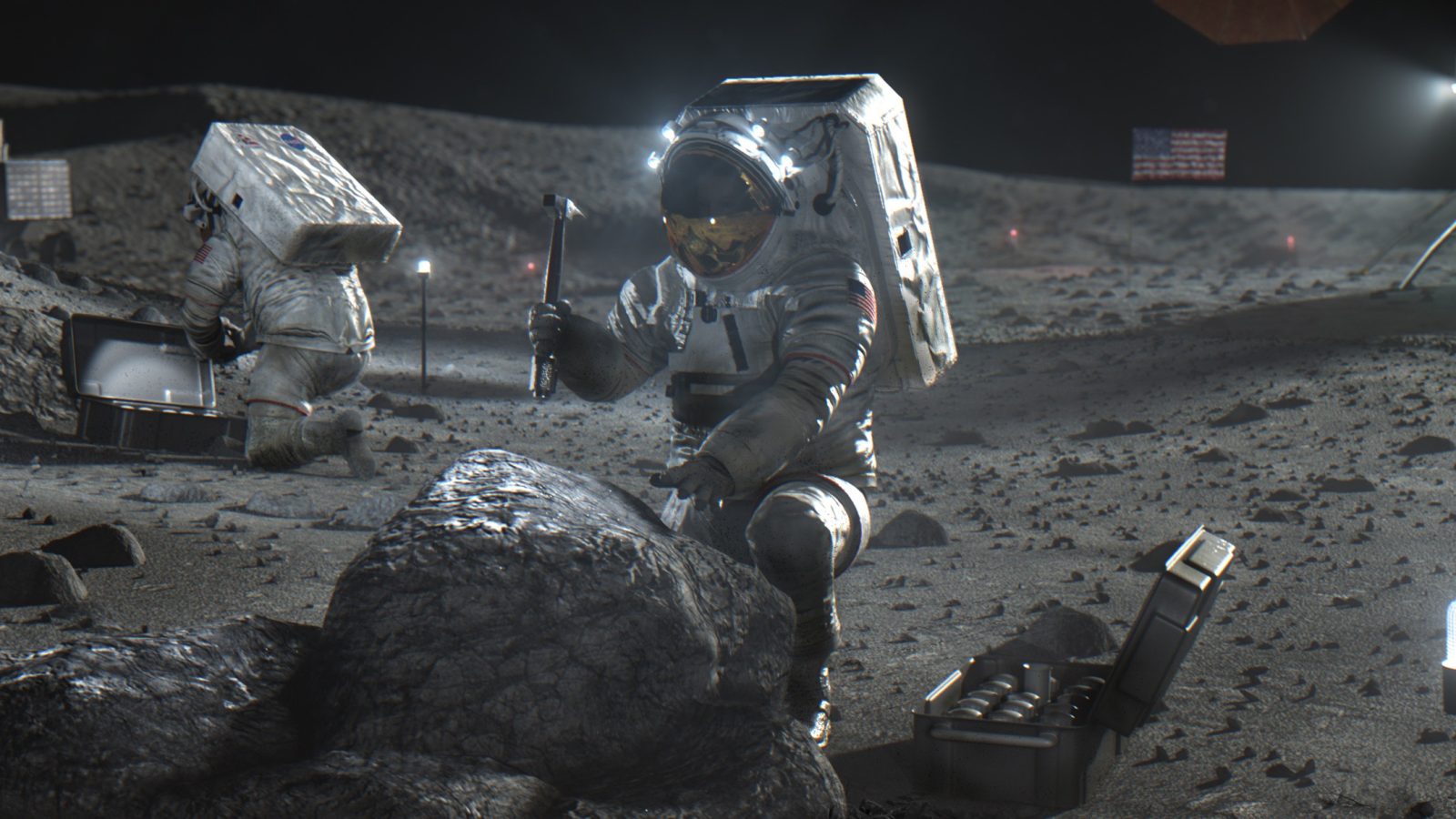
NASA is reportedly moving to simplify Axiom Space’s lunar spacesuit as the agency works toward returning astronauts to the surface of the Moon in 2028.
According to new reporting from Ars Technica, NASA and Axiom are developing a streamlined configuration of the Axiom Extravehicular Mobility Unit, or AxEMU, for the first Artemis lunar surface missions. The configuration is reportedly being called the “sortie suit” internally and would reduce some of the mass, complexity and longer-duration requirements built into the original suit design.
NASA has not publicly announced the sortie suit or detailed exactly which AxEMU requirements are being changed. But the report comes amid very real schedule pressure on a piece of Artemis hardware that is every bit as mission-critical as the spacecraft carrying astronauts to the Moon.
A spacesuit, be it designed for microgravity or the lunar surface, is essentially a small spacecraft built around a human body. The AxEMU must maintain pressure, provide oxygen, remove carbon dioxide and metabolic heat, manage humidity, provide communications and protect astronauts from radiation exposure, extreme thermal conditions and abrasive lunar regolith. At the same time, the suit has to remain mobile enough for astronauts to walk, kneel, bend and perform scientific and engineering tasks in one-sixth gravity.
That combination becomes increasingly difficult as requirements are added. Every additional layer, component and consumable has consequences for suit mass, mobility, thermal performance and the amount of qualification testing required before astronauts can use it on the Moon.
Some of NASA’s original requirements for AxEMU went considerably beyond a short initial lunar excursion. According to Ars Technica’s reporting, the suit was required to support as many as six extravehicular activities during a 6.5-day surface mission and remain capable of supporting additional EVAs after as much as 210 days in dormant storage.
Requirements also anticipated astronauts spending time inside permanently shadowed regions near the lunar south pole, where temperatures can fall dramatically below those experienced in sunlight.
Those capabilities matter to NASA’s eventual goal of sustained exploration of the lunar south pole. The question now appears to be whether all of them have to be incorporated and qualified in the version of the suit used for the first landings.
The reported sortie suit would answer that question by concentrating on what astronauts actually need for those early missions, while allowing more demanding capabilities to be incorporated as Artemis surface operations become longer and more complex.
There is no indication NASA intends to reduce fundamental crew-safety requirements. The distinction is between requirements necessary to keep an astronaut alive and functional on the lunar surface and operational requirements created for missions the first suit may not actually be asked to perform.
Removing a requirement can eliminate hardware, but it can also eliminate associated failure modes, software, interfaces, qualification work and test cases. And with the first Artemis lunar landing currently planned for 2028, time has become one of AxEMU’s most important engineering constraints.
NASA’s Office of Inspector General highlighted that problem in April.
NASA originally selected both Axiom Space and Collins Aerospace to provide next-generation spacesuit services under the agency’s xEVAS contract. Collins’ task orders were later removed by mutual agreement, leaving Axiom as NASA’s only active provider for its immediate lunar and microgravity spacesuit requirements.
The inspector general found that NASA’s original spacesuit development schedules had proved unrealistic. As of January, Axiom was working toward demonstrating its suits in late 2027, while significant testing and qualification remained.
The OIG concluded there was “little to no schedule margin” remaining for the spacesuit to support NASA’s planned 2028 lunar landing.
AxEMU itself is not an early prototype. Axiom has accumulated hundreds of hours of pressurized human testing, including underwater testing at NASA’s Neutral Buoyancy Laboratory. NASA reported late last year that the program had surpassed 700 hours of crewed pressurized testing and had completed its first dual-suit run in the NBL.

Testing a lunar suit underwater allows engineers and astronauts to evaluate mobility, body positioning and procedures in an environment where buoyancy can be adjusted to approximate some aspects of reduced-gravity work. It does not reproduce lunar gravity or the Moon’s thermal and dust environment, but it remains an important tool for evaluating how astronauts interact with hardware while wearing a pressurized suit.
The suit must also integrate with two very different lunar landers. SpaceX is developing a lunar version of Starship under NASA’s Human Landing System program, while Blue Origin is developing its Blue Moon Mark 2 lander. AxEMU has to function not only on the lunar surface but as part of the larger spacecraft system, including the physical and operational interfaces astronauts use while transitioning between a lander and the surface. Simplifying those interfaces is one of the goals of the reported sortie suit effort.
NASA may also get an opportunity to work through some of those integration problems before anyone takes the suit to the Moon. Under the revised Artemis architecture, Artemis 3 is now planned as a crewed demonstration mission in low Earth orbit in 2027 rather than a lunar landing.
NASA says the mission will test rendezvous and docking operations between Orion and commercial lunar lander hardware, and the agency is evaluating options to test interfaces between AxEMU and the landers during the mission. That would move some of the learning that otherwise would have occurred much closer to the Moon into Earth orbit, where the agency has considerably more options if hardware does not behave as expected.
Artemis 4 is then targeted to conduct the first Artemis lunar landing in early 2028.
The reported change to AxEMU therefore fits into a broader engineering problem NASA is confronting across Artemis: deciding which capabilities are necessary for the next flight and which can mature later.
That is not unusual in spacecraft development. Designing hardware from the beginning for every anticipated future mission can produce systems that are heavier, more complicated and harder to qualify than those needed for the immediate objective.
For Artemis, that trade becomes particularly important because the lunar spacesuit has an unusual role in the mission architecture. Once an astronaut leaves the lander, the suit becomes that astronaut’s spacecraft.
For hours at a time, the astronaut depends on it for pressure, oxygen, thermal control, carbon dioxide removal, communications and protection from an environment in which even a relatively small system failure can become life-threatening.
SpaceX and Blue Origin can successfully deliver astronauts to the lunar surface, but without a flight-ready spacesuit those astronauts cannot accomplish the work NASA is sending them there to do.
That makes AxEMU one of the smallest pieces of the Artemis architecture, and one of the pieces NASA can least afford to arrive late.
If the reported sortie suit approach is successful, NASA would not be abandoning the more capable lunar spacesuit it ultimately wants. Instead, Axiom would deliver the capabilities needed for the first lunar missions and continue evolving the suit as Artemis moves toward longer surface stays and more difficult environments.
After years of designing a spacesuit for NASA’s future on the Moon, the immediate engineering question may have become much simpler: What does an astronaut need to safely step onto the Moon in 2028?


FTC: We use income earning auto affiliate links. More.



Comments