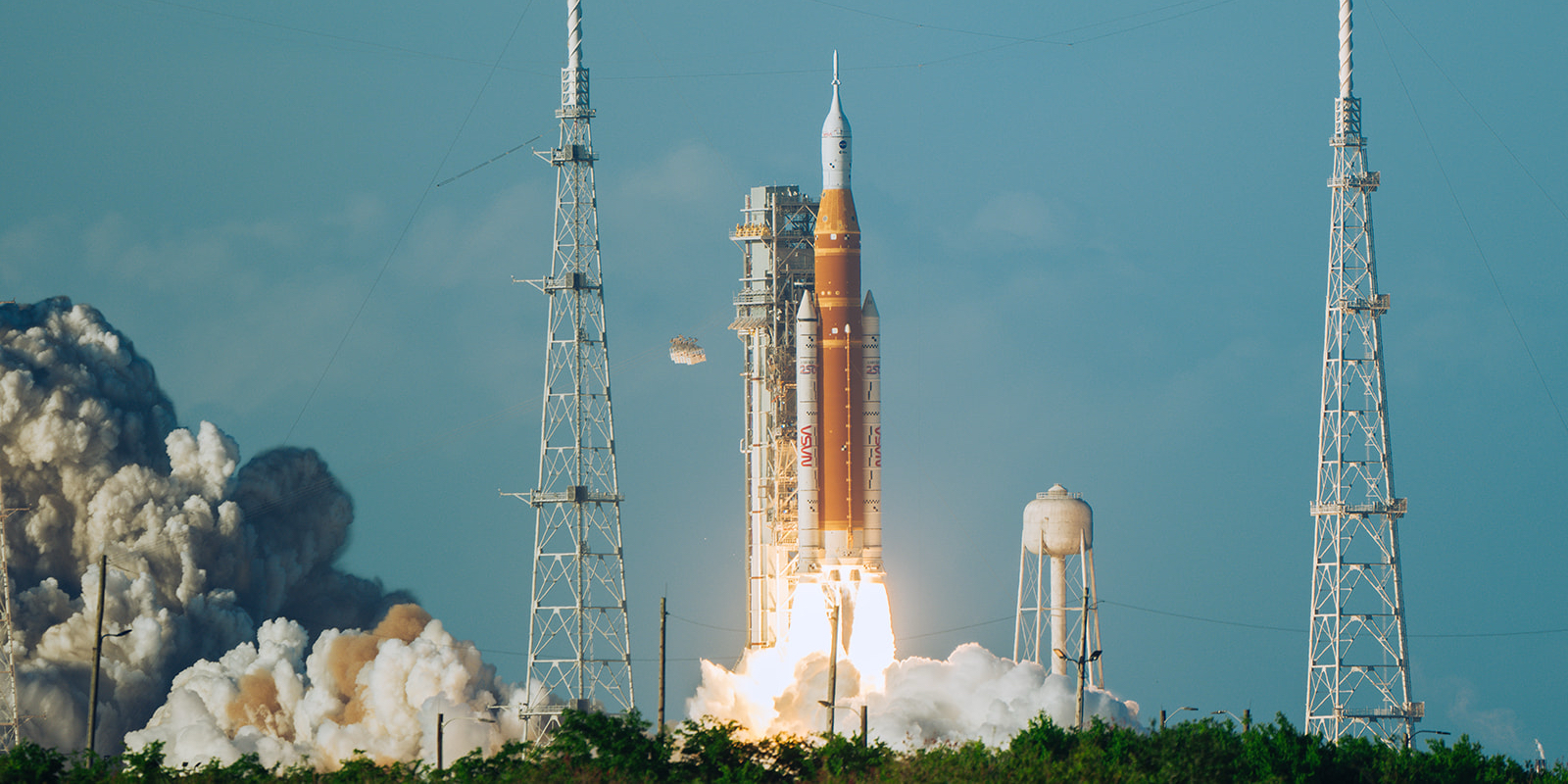
For the first time in over 50 years, humans are on their way to the Moon



NASA published a challenge for K-12 students to design a robot capable of digging and transporting lunar regolith.
Expand Expanding Close
NASA has announced that it will hold a virtual media briefing to discuss new findings from the Juno spacecraft.
Expand Expanding Close
Blue Origin announced on Monday official plans to build a commercial space station named Orbit Reef.
Expand Expanding Close
Last night Arianespace launched their 111th Ariane 5 mission to space carrying satellites for SES and the French military. This marked its final flight of the Ariane 5 before it launches NASA’s James Webb Space Telescope in December.
Expand Expanding Close
Today we’ve almost become numb to the stunning high-quality satellite images we get of our planet daily. But prior to 1946, people had never seen the Earth from space.
Expand Expanding Close
NASA Office of Stem Engagement awarded $28 million to jurisdictions around the country today to keep their research competitive compared to other programs with more outside funding, details below.
NASA has awarded $28 million to fund the next five years of research infrastructure development across 28 jurisdictions. The Established Program to Stimulate Competitive Research (EPSCoR), a part of NASA’s Office of Stem Engagement and based out of the agency’s Kennedy Space Center in Florida, supports science and technology research and development at colleges and universities while also funding studies in Earth science, aeronautics, and human and robotic deep space exploration – all of which are disciplines critical to the NASA mission.
Started almost 30 years ago, EPSCoR focuses on 25 states and three territories, and seeks to lessen the disparity in funding between states across the nation to create an equitable competition in aerospace and aerospace-related research activities. While California receives 12% of all federal research funding, all 28 EPSCoR jurisdictions combined receive less than 10%, so participating states and territories depend heavily on these research investments. NASA funds these areas so they remain competitive in the aerospace research and development field.
The EPSCoR Research Infrastructure Development award further strengthens long-term research capabilities by pledging $200,000 a year to each of the 28 jurisdictions for the next half decade, increasing and diversifying technology and research development, higher education, and economic development on both a state and national level.
EPSCoR also solicits proposals for Rapid Response Research, which awards funding to researchers as they work with NASA on issues impacting the agency’s mission and programs, as well as International Space Station collaborations and suborbital flight opportunities, which provide researchers the opportunity to fly mature research projects in low-Earth orbit.
Jurisdictions receiving the RID awards are: Alabama, Alaska, Arkansas, Delaware, Guam, Hawaii, Idaho, Iowa, Kansas, Kentucky, Louisiana, Maine, Mississippi, Montana, Nebraska, Nevada, New Hampshire, New Mexico, North Dakota, Oklahoma, Puerto Rico, Rhode Island, South Carolina, South Dakota, Vermont, the U.S. Virgin Islands, West Virginia, and Wyoming.
To learn more about EPSCoR, visit:
The Russian cargo ship “Progress 78” relocated to the Nauka module this Friday. There the spacecraft will allow the crew to conduct tests on the brand new module.
Expand Expanding Close
NASA representatives released launch windows for the agency’s Artemis I mission, launching on the newly stacked Space Launch System, in a call with the media.
Expand Expanding Close
It has been a long time since we’ve seen engines test-fired in Starbase, but Thursday afternoon, SpaceX did not just one but two. These tests mark a significant milestone for Vacuum Raptor development.
Expand Expanding Close
Earlier this year, we reported that NASA was planning on constructing the Mobile Launcher 2 tower sections on a plot of land located in Port Canaveral. Now it appears that this site has relocated to Kennedy Space Center.
Expand Expanding Close
This week the FAA hosted two public comment hearings for SpaceX’s Starship facility in Boca Chica, Texas. Both sessions lasted for about five hours, with over 100 commenters speaking with more not making the time cut. The hearings had two overall points made by commenters, “SpaceX is hurting our environment and way of life” and “move out of the way FAA and let Elon do Elon things.”
Expand Expanding Close
Astronomers have discovered a new astronomical phenomenon in which a white dwarf star has been switching “off and on,” with its brightness abruptly dimming and intensifying in just 30 minutes.
Expand Expanding Close
Students across Alabama have been working on being the first student-built CubeSat to leave low-Earth orbit. Now that dream is no more after NASA dropped secondary payloads from the Artemis II mission. Thus, forcing the Alabama Space Grant Consortium that leads the project to pivot its design.
Expand Expanding Close
You will likely recognize the name “Nanoracks” for its Bishop airlock that launched to the International Space Station last year, but this project will forever cement the name “Nanoracks” in the history books. Today, Nanoracks introduced Starlab, the first-ever continuously crewed, commercial, free-flying space station.
Expand Expanding Close

Lunar rovers are typically four-wheeled electric vehicles, but a new prototype shows how a two-wheeled electric motorcycle may have serious advantages on the moon.
Read More
Artemis I is finally within view as SLS nears completion. Wednesday, the Orion capsule was lifted onto the SLS rocket within the Vehicle Assembly Building.
Expand Expanding Close
NASA released a formal notice for new crewed rides to the International Space Station, answering the question what happens after SpaceX and Boeing finish their contracts.
Expand Expanding Close

This week on the Space Explored Podcast, Seth Kurkowski and Derek Wise discuss the launch of William Shatner and NASA’s Lucy mission, the Senate’s NASA budget proposal, and the FAA’s first public comment hearing for SpaceX’s Starship.
The US Air Force and the US Department of Defense recently funded research into the possible use of 5G as radar-like surveillance equipment.
Expand Expanding Close
In a blog post on NASA’s Lucy website, the teams announced that the spacecraft is healthy, but they are looking into an issue with one of Lucy’s giant solar arrays.
Expand Expanding Close
In August, Boeing attempted to launch its second Orbital Flight Test mission to the International Space Station but was plagued by valve malfunctions. Since then, Boeing and NASA have been giving updates on where they are with returning to launch.
Expand Expanding Close
The Orlando Air and Space Show took flight this past weekend at the Orlando Sanford International Airport. Space Explored’s Derek Wise and Jared Locke were at the show to capture the flights.
Expand Expanding Close

Berkeley, California-based carbon transformation company Twelve and Tulsa-based Emerging Fuels Technology (EFT) today announced that they have produced the first fossil-free jet fuel from carbon dioxide using an electrochemical process. The project received funding from the US Air Force.
Read More
Since 2000 humanity has had a constant presence of individuals orbiting the Earth onboard the International Space Station. With the rise of commercial opportunities to reach for the stars, and other nations begin their crew launch programs, when is the next crewed launch?
Expand Expanding Close


