SpaceX (Space Exploration Technologies Corp.)

SpaceX is a private spaceflight company, founded in 2002 by billionaire Elon Musk. With the goal to get people excited about the future, he believed that the best way to do that was by expanding humanity out into the stars.
Table of contents
Brief Overview
With the eventual goal to inhabit Mars, SpaceX has dramatically increased the reusability of orbital rockets and increased the accessibility of space. Since its founding, the private space company has developed and produced multiple different launch vehicles including the Falcon 9, Falcon Heavy, and Starship. More recently, they have created a satellite constellation known as Starlink to provide high-speed internet access around the world.
The Founding
In 2002, Musk was already extraordinarily wealthy. Having sold PayPal to eBay for $1.5 billion, Musk walked away with over $100 million and had goals to inspire the world with space travel. His goal was to put a greenhouse on Mars. To grow plants on Mars would be no easy task, but he saw this project as sending life the farthest it’s ever traveled and hoped to improve public interest in space and increase NASA’s budget.
In late 2001, Musk had traveled to Moscow with the intention of purchasing refurbished ICBMs to launch the project. He was unable to find a ride to space for an acceptable price. At one point, he even considered the venerable Delta II rocket. Left empty-handed, Musk was confident that he could improve access to space by dramatically decreasing launch prices. He started building out the original SpaceX team in early 2002, and the company was founded that May.
Books about SpaceX
- Elon Musk (2023) by Walter Isaacson
- Elon Musk (2015) by Ashlee Vance
- Rocket Billionaires by Tim Fernholz
- The Space Barons by Christian Davenport
- Liftoff by Eric Berger
SpaceX Rockets
For the last two decades SpaceX has been developing and improving its Falcon family of rockets to be the most cost effective and capable rides to space. The company now leads the world in the total launches while also continuing to innovate and disrupt the industry.
Falcon 1
The Falcon 1 was the first rocket developed by SpaceX from the companies founding through 2009. Upon reaching orbit in 2008, it became the first privately developed fully liquid-fuel rocket to do so. The Falcon 1 first stage was designed to be reusable. A parachute-based system would recover the first stage, but the system was never successfully demonstrated.
A single Merlin Engine powered the first stage, with the second stage being powered by a Kestrel Engine. The first two, unsuccessful flights, relied on the expendable, ablatively cooled Merlin 1A. The next three flights used a regeneratively cooled Merlin 1C. That regenerative cooling caused the first Falcon 1 flight to make use of the 1C to fail. The extra propellant used to cool the nozzle provided a slight amount of thrust. This additional thrust causing the first and second stage of Falcon 1 to collide after stage separation. After these failures, Falcon 1 saw two successful flights, the first, “Ratsat”, being a demonstration that carried only a mass simulator. The second carried RazakSAT, a Malaysian Earth observation satellite into orbit. As Falcon 1 was retired, plans for an upgrade, the Falcon 1e, were also canned in favor of the Falcon 9.
Falcon 9
Falcon 9 is SpaceX’s workhorse vehicle. The reusable first stage is capable of returning to land near the launch site or out in the ocean on mobile droneships. Powered by 9 Merlin 1D engines on the first stage, and a single Merlin 1D Vacuum optimized engine on the second stage, the Falcon 9 uses a combination of liquid oxygen and RP-1, a highly refined kerosene. Development on the Falcon 9 began in 2005, and the first launch occurred on June 4th of 2010. The Falcon 9 has seen many interactions and consistent improvement, increasing both reliability and reusability with each change.
Falcon 9 versions
- Version 1.0: 2010 – 2013
- Version 1.1: 2013 – 2016
- Version 1.2 “Full Thrust”: 2015 – Included in Block 5
- Block 5: 2018 – Present
So far SpaceX has shown it can fly its Falcon 9 boosters up to 18 times.
Falcon 9 has also become SpaceX’s first crew-rated rocket, launching multiple crews in the companies Crew Dragon capsule to space.
Falcon Heavy
The Falcon Heavy is SpaceX’s heavy lift launch vehicle. Discussion on the concept of the Falcon Heavy were occurred as early as 2003, but plans were publicly unveiled in 2011. SpaceX drew heavily from their experience with the Falcon 9, using what is essentially a strengthened Falcon 9 booster for the core stage, and two more as strap on boosters. The Falcon Heavy test flight in 2018 carried Musk’s personal first generation Tesla roadster out of Earth orbit.
While a Tesla Roadster is an eccentric payload, it only served as a mass simulator for a test flight that very easily could have gone wrong. While it took a while to get the Falcon Heavy launch cadence up and going, starting in 2022, SpaceX began launching the rocket more regularly. SpaceX received contracts from the US Space Force to launch its highly sensitive national security missions on the rocket, with it began flying in 2022. In the future, Falcon Heavy will begin supporting NASA’s Artemis missions by flying the Power and Propulsion Element and Habitation and Logistics Outpost for the Lunar Gateway.
However, eventually Falcon Heavy will be replaced with a much larger and cost effective rocket still under development called Starship.
Starship
SpaceX’s latest rocket, Starship, is currently being developed in Boca Chica, Texas or Starbase. Starship makes use of a new engine, the Raptor, as Starship uses Methane rather than RP-1 as a fuel. This use of Methane is essential, as SpaceX’s goal is for Starship to be the vehicle to bring humans to Mars. Methane can be generated with carbon dioxide and the water from ice on Mars. This opens the possibility of refueling and launching back to Earth. Starship booster, known as Super Heavy, may have up to 32 raptor engines once development is complete. Development is moving quickly, and SpaceX is aiming to have an orbital flight of Starship by the end of this year. Starship will have both a reuseable first and second stage. The second stage will land in a unique bellyflop profile to reduce the amount of fuel needed to land.
In 2019 SpaceX began low altitude test flights with a sub-scale vehicle called Starhopper. These were the first flights using the new Raptor engine and paved the way for engineers to better understand how the engine performs. SpaceX then moved on to full scale mockups in 2020.
In late 2020 SpaceX conducted its first high altitude fight of a Starship vehicle called SN8. The first flight flew up to 12.5 km with the following four flights flying to 10 km. The goal of this campaign was to gather flight data during ascent with three Raptor engines and during descent in its belly flop maneuver. The campaign ended with SN15 in May of 2021 with a successful landing of the Starship vehicle.
After that, SpaceX took almost two years before flying again, using this time to develop its Super Heavy booster and prepare the rocket for an orbital attempt. SpaceX also ran into some regulatory red tape to make its new orbital launch site operational by the FAA. On April 20, 2023 The first fully integrated Starship rocket lifted off from SpaceX’s Starbase facility in Boca Chica, Texas.
While the flight was terminated before stage separation, it was a major step forward. We are currently awaiting SpaceX’s next orbital launch attempt with a new Starship vehicle and Super Heavy Booster.
There are extremely ambitious plans for the Superheavy Booster recovery. Musk shared on then Twitter (now X) that SpaceX plans to catch the booster with the launch tower, using the grid fins to support the booster.
Starship (HLS)
In 2021, SpaceX was selected by NASA to build a lunar version of its Starship rocket to land Artemis astronauts on the lunar surface. This version of Starship will ditch any reusability features but add it larger solar panels, a elevator for getting down to the surface, and landing thrusters towards the top of the ship.
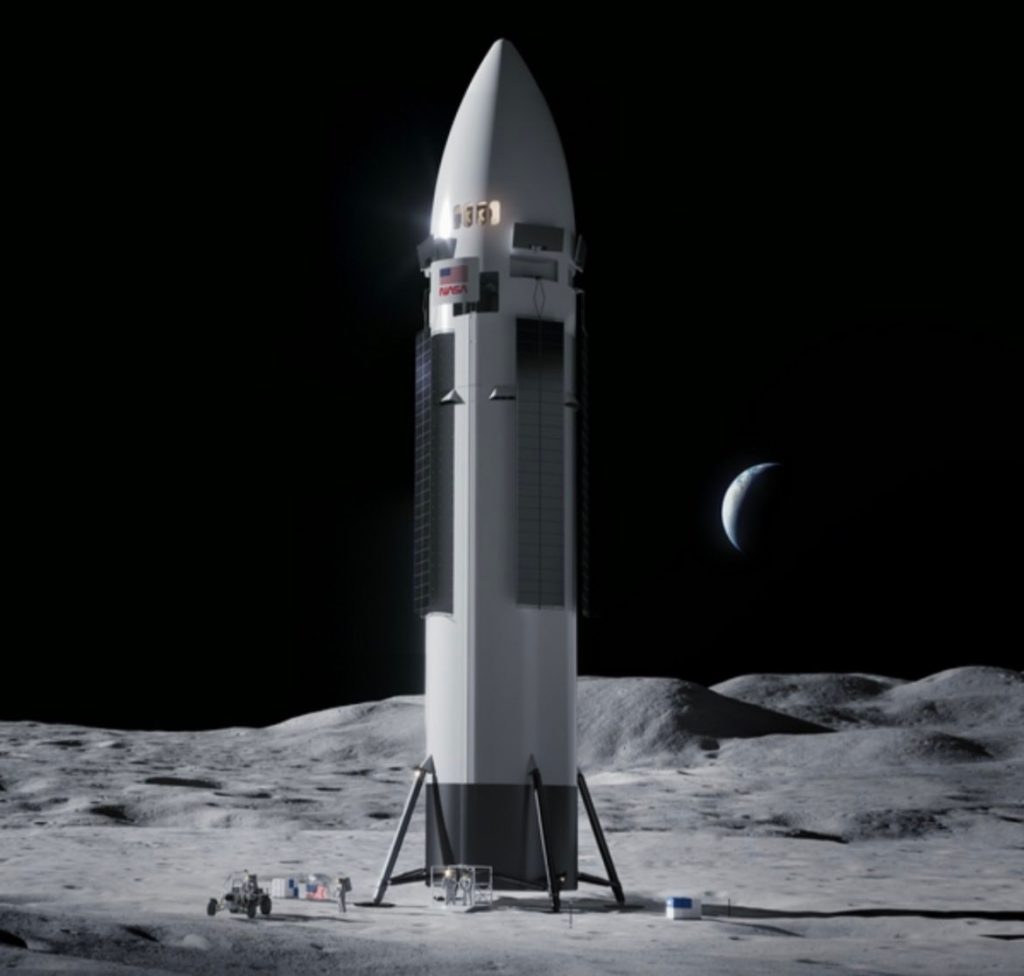
NASA’s HLS Starship development is linked to the Starship’s regular development and every delay to it means a delay to getting Starship ready by Artemis 3 in 2026.
Starlink
SpaceX announced its Starlink satellite internet constellation back in 2016. The company has had interest in creating a similar service since early on in its career. In 2004 SpaceX acquired a stake in Surrey Satellite Technology as a strategic partnership but sold its stake when the company transitioned to Earth observation technology.
Then in 2014, Elon Musk and Greg Wyler began discussions of partnering up with what was then called WorldVu, which later was renamed to OneWeb. Those discussions fell apart later that year and SpaceX began development on its own product. Of which it began launching and deploying in 2018.
Starlink now consists of over 5,000 satellites in orbit and is the largest constellation ever developed. Rather than developing partnerships with businesses or governments to provide service, Starlink sells its services directly to the consumer who can purchase a small satellite dish starting at $599, then a monthly fee.
According to Musk, Starlink achieved “break even cashflow” towards the end of 2023. While that doesn’t tell us exactly if the service is profitable yet, it’s a step in the right direction. As of September of 2023, Starlink had more than two million subscribers.
List of SpaceX launches
- 2010: 2 launches
- 2011: 0 launches
- 2012: 2 launches
- 2013: 3 launches
- 2014: 6 launches
- 2015: 7 launches
- 2016: 8 launches
- 2017: 18 launches
- 2018: 21 launches
- 2019: 13 launches
- 2020: 26 launches
- 2021: 31 launches
- 2022: 61 launches
- 2023: 84 launches (As of November)


